Compact vs full car emergency kits for roadside preparedness
A compact car emergency kit or full car emergency kit depends on coverage, storage, driving distance, and tolerance for missing functions. The car emergency kit should support roadside preparedness without creating a storage burden that makes the kit hard to keep in the vehicle.
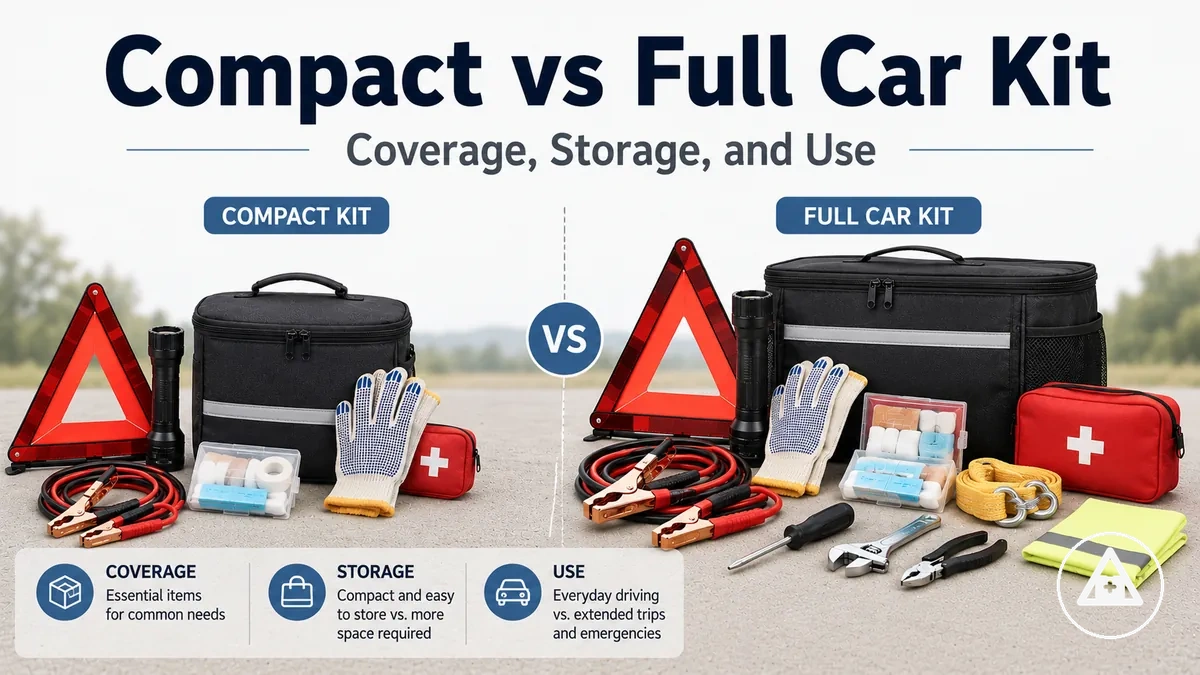
A compact kit is easier to store but usually has limited coverage; a full kit usually offers broader coverage with more tools, size, and weight. That tradeoff matters because storage space can affect whether the kit stays accessible during daily driving or longer trips.
The decision support should start with the vehicle, the usual driving distance, the likely roadside problem, and the functions already covered by other items. A compact car emergency kit may suit short routine driving when storage is tight, while a full car emergency kit may suit longer trips or higher uncertainty.
The compact-versus-full boundary is not only about bag size. A smaller kit can be practical when it covers the most relevant roadside functions, while a larger kit can still be weak if the extra pieces do not improve useful coverage.
For broader article context, the car emergency kit hub connects this size comparison to contents, storage, maintenance, and selection criteria. The safer fit depends on vehicle space, trip pattern, and which missing functions would matter during a roadside problem.
What changes between compact and full car emergency kits
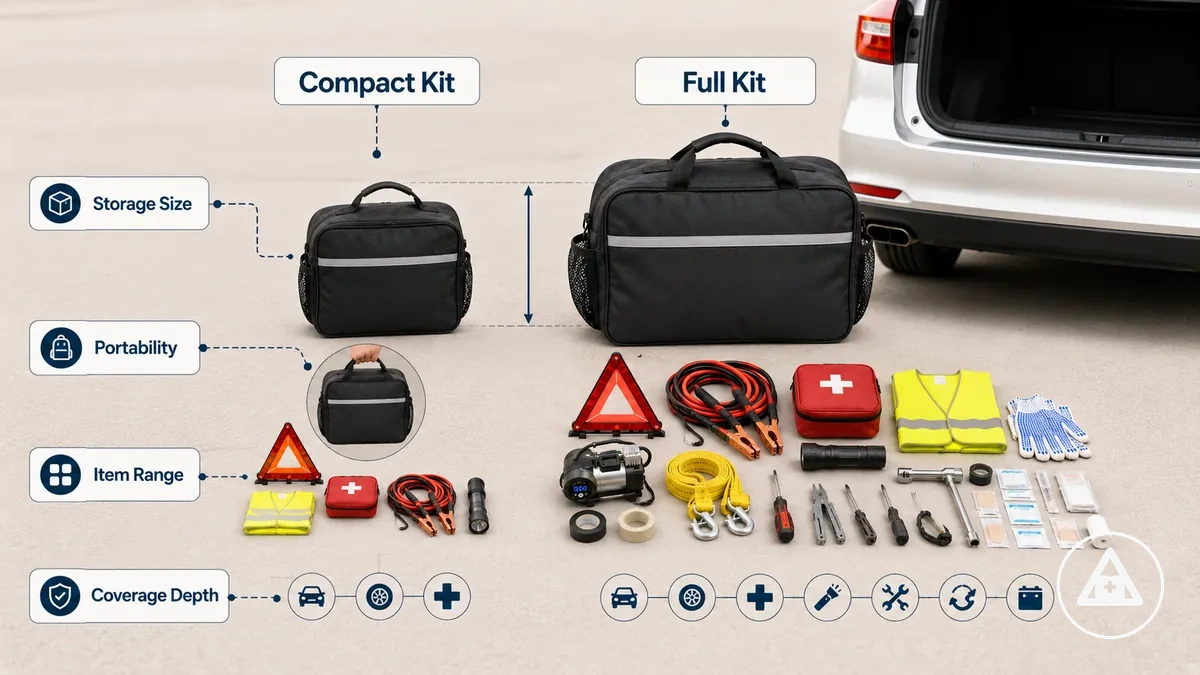
Compact kits and full kits mainly differ in coverage depth, storage size, portability, and use-case fit. A compact car emergency kit usually prioritizes easier storage and transport, while a full car emergency kit typically provides broader roadside preparedness through a wider item range.
What changes between compact and full car emergency kits becomes clearer when comparing the core differences below.
| Compact Kits | Full Kits |
|---|---|
| Smaller storage size | Larger storage footprint |
| Higher portability | Lower portability due to added contents |
| More limited item range | Broader item range |
| May suit tighter vehicle space | May suit vehicles with more storage capacity |
| Narrower coverage depth | Broader emergency coverage potential |
Coverage depth, item range, storage size, and portability are connected because each change can affect access to roadside functions during an emergency. The car emergency kit decision should consider available vehicle space and the intended use-case fit rather than focusing on size alone.
A larger car emergency kit is not automatically more useful than a smaller one. Usefulness depends on whether the compact kit or full kit includes the roadside functions needed for the vehicle and travel pattern.
Coverage differences by kit size
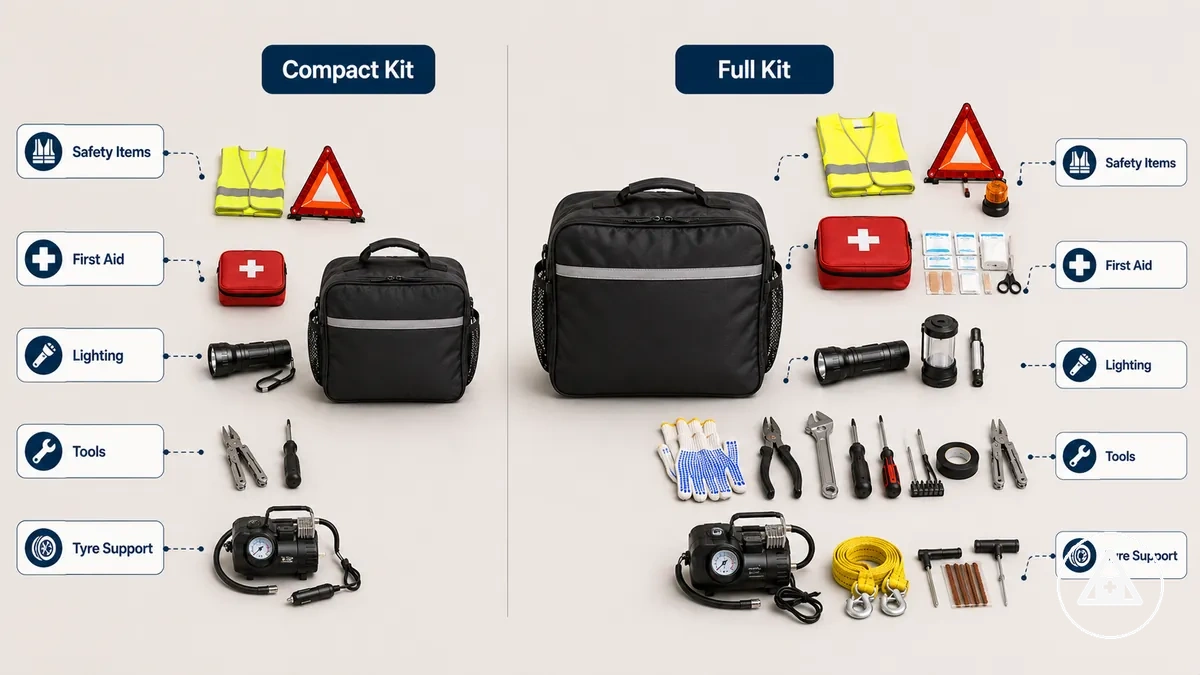
Coverage differences by kit size are mainly about emergency functions rather than raw size or item count. A compact car emergency kit often focuses on core roadside preparedness functions, while a full car emergency kit may extend coverage into additional support areas when configurations include them.
Coverage differences by kit size become easier to evaluate when function groups are compared side by side.
| Function group | Compact kit coverage | Full kit coverage | Decision effect |
|---|---|---|---|
| Safety items | Usually covers core visibility functions | Often includes broader safety support | Affects basic roadside preparedness |
| First aid | Often covers common first aid needs | May provide wider first aid coverage | Affects response flexibility |
| Lighting | Usually includes basic lighting support | May add broader lighting options | Affects visibility conditions |
| Tools | May omit expanded tool functions | Often adds more tool coverage | Affects roadside problem support |
| Tyre support | May provide limited tyre support | Often includes broader tyre-related functions | Affects recovery options |
| Comfort supplies | Usually limited | May include additional support items | Affects waiting and travel conditions |
The strongest coverage differences often appear beyond safety items, first aid, and lighting. Full kit configurations may add tools, tyre support, and comfort supplies that expand function coverage, while compact kit configurations may prioritize essential roadside functions and portability.
Coverage depth should be judged by the functions included rather than kit size alone. For a closer comparison of category-level contents, see contents by kit size; the more suitable option depends on which roadside preparedness functions matter for the vehicle and travel pattern.
Core safety and first aid coverage in compact kits
Core safety and first aid coverage in compact kits focuses on lightweight support for common roadside situations and short-distance preparedness. A compact kit is smaller and narrower in coverage, but it often provides visibility support, basic first aid resources, and a few practical roadside essentials.
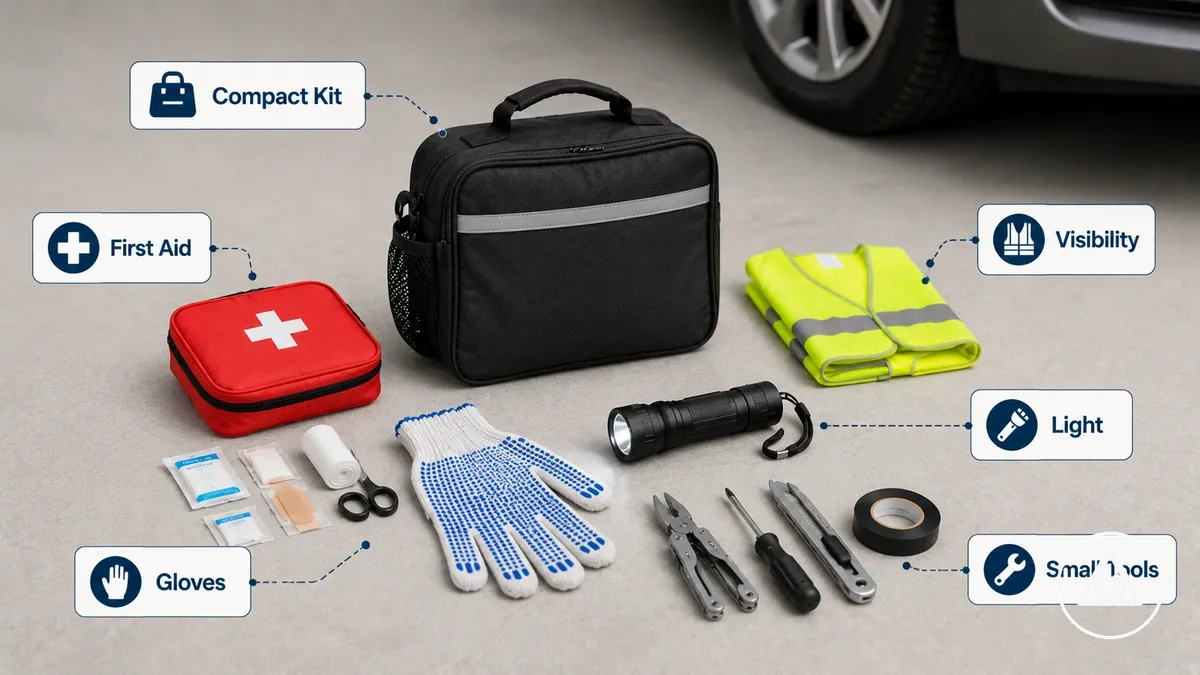
- Core safety items often support visibility during roadside stops, although included contents may vary.
- First aid supplies may help address basic roadside needs, but first aid coverage can differ by configuration.
- A light can support visibility in low-light conditions, while gloves may assist with simple roadside tasks.
- Small tools may help with minor situations, although function coverage is usually limited compared with larger setups.
Compact kit coverage may omit heavier recovery tools or broader tyre support functions. This limited coverage can suit short-distance preparedness when expected roadside needs remain relatively simple.
Expanded roadside tools and comfort supplies in full kits
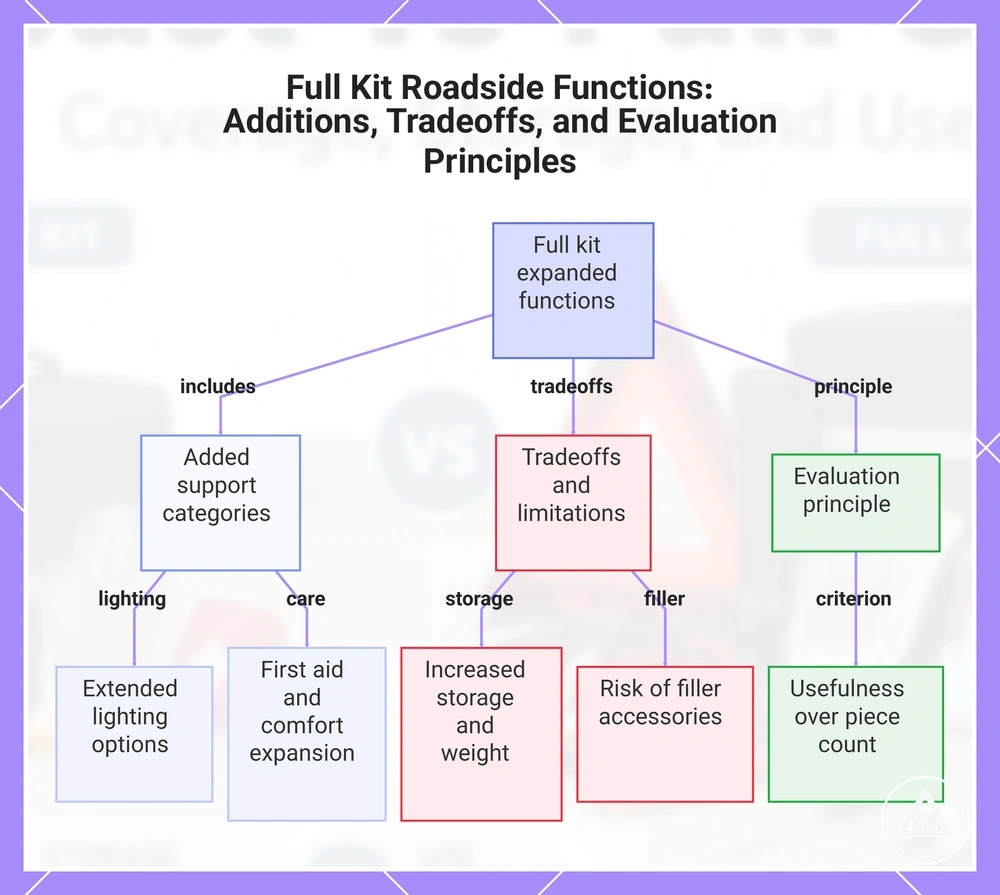
Expanded roadside tools and comfort supplies in full kits usually broaden roadside functions beyond the compact-kit baseline. A full kit often adds more support categories for longer waits, more varied roadside problems, and wider preparedness needs, although the added coverage comes with a storage tradeoff.
- Expanded tools may support a wider range of roadside situations than basic visibility and first aid functions alone.
- Lighting options often extend beyond a single light source and may improve visibility under different conditions.
- First aid coverage may include additional supplies that broaden response options, although contents vary by configuration.
- Comfort supplies can support passengers during waiting time and may improve roadside readiness in extended situations.
- Additional roadside functions may increase preparedness flexibility, but they also increase storage space and carrying weight.
Useful added functions should be judged by their contribution to roadside preparedness rather than piece count alone. A full kit may include filler accessories that add little practical value, so broader coverage depends on the usefulness of the added functions as much as the number of included items.
This chart shows what expanded functions full roadside kits add over compact kits, the associated tradeoffs, and the key evaluation principle for judging added value.
Storage size and portability tradeoffs
Storage size and portability tradeoffs affect readiness because kit size influences access, vehicle space use, and daily usability. A compact kit usually reduces storage burden and improves portability, while a full kit often increases coverage at the cost of a larger bag footprint and greater weight.
Kit size affects where a car emergency kit can realistically be stored and how quickly it may be accessed during a roadside situation. Vehicle space, access location, bag footprint, and weight can influence whether a compact kit or full kit remains practical for regular use.
Storage size and portability tradeoffs change convenience, readiness, and coverage compromise. The table below summarizes how common storage factors can affect access and daily usability.
| Storage factor | Compact kit effect | Full kit effect | Decision note |
|---|---|---|---|
| Bag footprint | Smaller footprint | Larger footprint | Affects available vehicle space |
| Weight | Easier to carry | Greater storage burden | Affects portability |
| Access | May fit nearer common access locations | May require more storage space | Access depends on placement |
| Vehicle space | Uses less cargo space | Uses more cargo space | Depends on available storage capacity |
Easy storage should not remove essential roadside coverage simply to reduce size. For readers considering where to store a kit, the most practical choice often depends on balancing access, readiness, and coverage needs for expected travel conditions.
Travel-size kits for limited vehicle space
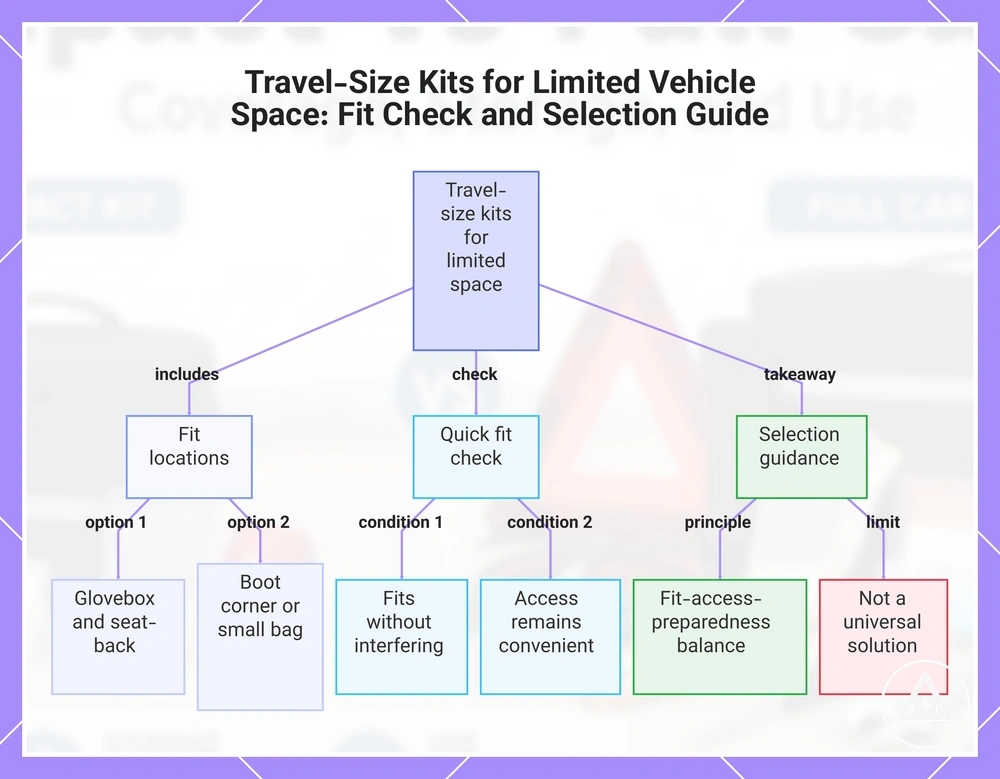
When limited vehicle space makes larger emergency supplies difficult to accommodate, a travel-size kit can provide a more practical fit while keeping a car emergency kit available for roadside preparedness. A compact kit may fit more easily in a glovebox-sized area, a seat-back compartment, a boot corner, or a small storage bag, although the exact fit depends on vehicle layout and kit dimensions.
Travel-size kits are most useful when access remains practical and the compact kit still supports expected roadside needs. A quick fit check can help:
- The compact kit fits within the available space without interfering with normal vehicle use.
- Access remains reasonably convenient during a roadside situation.
- A glovebox area, seat-back compartment, boot corner, or small storage bag can accommodate the travel-size kit.
- Limited vehicle space does not require removing essential preparedness functions.
For example, a smaller city vehicle with restricted cargo capacity may benefit from a compact emergency kit when a larger setup would be difficult to store. The most suitable choice depends on balancing fit, access, and preparedness rather than assuming a travel-size kit will meet every roadside requirement.
This chart shows how travel-size kits provide a practical fit for limited vehicle space, the quick fit check to verify compatibility, and the key factors for selecting the most suitable kit.
Larger kits for trunk or cargo storage
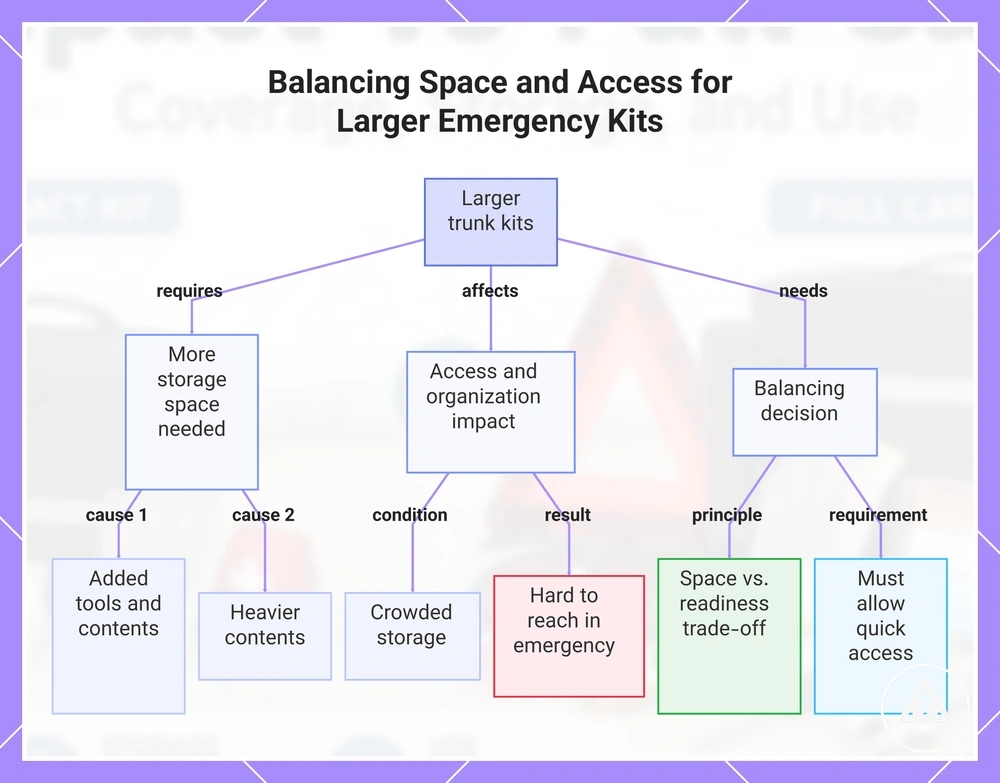
A larger kit usually requires more trunk storage or cargo storage because added tools and heavier contents increase the overall bag size. A full kit often includes a larger bag that takes up more vehicle space, so a car emergency kit with broader coverage may need a more stable storage location than a compact alternative.
Full kits can affect access and organization when trunk storage or cargo storage becomes crowded or difficult to reach during a roadside problem. Larger kits should still allow reasonably quick access when needed, and the most practical storage approach depends on balancing available space, organization, and readiness for expected travel conditions.
This chart shows the main factors to consider when choosing a larger emergency kit for trunk or cargo storage, including space requirements, access impact, and the need to balance organization and readiness.
Driving situations that change the better kit choice
When driving situations change, the better kit choice depends on distance from help, passengers, weather exposure, and storage tolerance rather than size alone. A car emergency kit should match the coverage level that may be useful in the travel context, because different driving situations can change roadside support needs.
In lower-uncertainty daily driving situations, a compact kit may be a practical fit when help is usually more available and storage tolerance is limited. The kit choice often favors a smaller setup when coverage needs remain relatively simple and vehicle space is an important consideration.
In higher-uncertainty travel conditions, greater distance from help, passengers, waiting time, and weather exposure may increase the desired coverage level. A full kit can be a better fit when the driving situation creates broader preparedness needs, although it usually requires accepting a larger storage burden.
Driving situations change the better kit choice by influencing the coverage level that may be needed during a roadside problem. The matrix below highlights common decision signals.
| Driving situation | Main condition | Better fit | Why |
|---|---|---|---|
| Routine daily driving | Lower uncertainty and limited storage tolerance | Compact kit | May provide suitable coverage while using less space |
| Regular commuting with passengers | Passenger needs may increase support requirements | Depends on coverage level needed | Passenger needs can influence preparedness priorities |
| Regional travel | Greater distance from help | Full kit | May support broader roadside needs |
| Travel with weather exposure | Longer waits or changing conditions | Full kit | Additional coverage may improve preparedness flexibility |
For readers focused on choosing by driving needs, the most suitable option usually depends on matching coverage level to the driving situation rather than relying on the compact or full label alone.
Daily driving and short-distance roadside needs
Daily driving and short-distance travel can make a compact kit a suitable choice when routine driving usually involves easier storage access, limited vehicle space, and common minor roadside needs. A compact car emergency kit may be enough for commuting, local trips, and everyday driving when preparedness needs remain relatively simple and quick storage access supports routine use.
Daily driving conditions can change the suitability of a compact kit when routes involve a remote commute, weather exposure, or poorly serviced areas. In those situations, fuller coverage may still be worth considering because a compact kit becomes less suitable when roadside support may be harder to reach, although the final decision depends on the travel context and preparedness needs.
This chart shows when a compact car emergency kit is a suitable choice for daily driving and which conditions may require fuller coverage.
Long trips and higher-uncertainty roadside needs
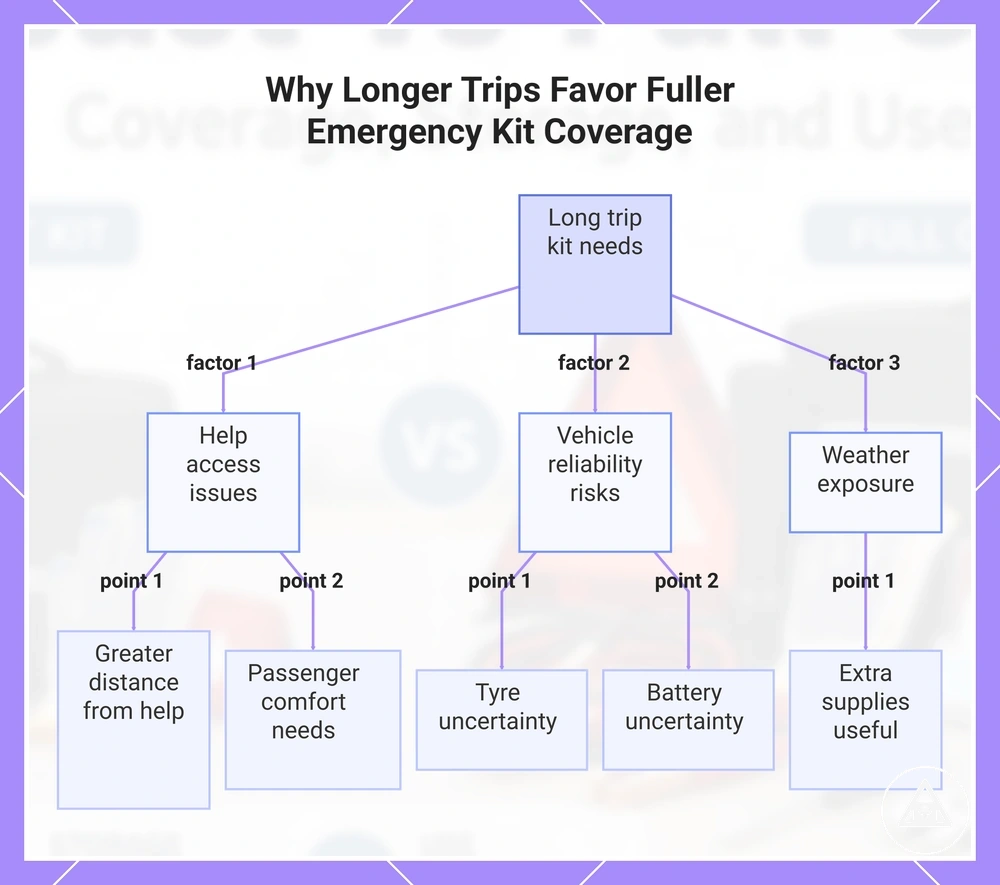
Long trips usually increase higher uncertainty because distance from help, time on the roadside, and changing travel conditions may affect preparedness needs. A car emergency kit with fuller coverage can become more suitable when longer trips expose drivers and passengers to situations where assistance may not be immediately available.
Longer trips may favor fuller coverage because additional needs can become more relevant during extended travel:
- Greater distance from help may increase the value of broader preparedness support.
- Passenger comfort can become more important when waiting time is longer than expected.
- Tyre uncertainty may justify additional roadside support options during travel driving.
- Battery uncertainty can increase the benefit of broader preparedness resources when assistance is delayed.
- Weather exposure may make extra supplies more useful when conditions change during travel.
For travel situations that require more detailed planning, long-trip kit needs provides additional context, although the most suitable coverage level still depends on route conditions, help availability, vehicle condition, and overall travel uncertainty.
This chart shows the key factors that make a fuller car emergency kit more suitable for long trips, including help access, vehicle reliability, and weather exposure.
Piece count and price signals in compact and full kits
Piece count and price signals can help compare a car emergency kit, but neither proves quality or preparedness on its own. A higher piece count or different price cue should be treated as a decision signal that requires checking useful functions and likely coverage outcome.
Useful functions matter more than item count because a compact kit or full kit may reach a similar coverage outcome through different function groups. Comparing the roadside functions included often reveals more indicative value than comparing numbers alone.
| Signal | What it can show | What it can hide | How to judge it |
|---|---|---|---|
| Piece count | Item quantity or kit count | Useful function gaps | Check whether the count supports meaningful coverage |
| Price signals | Indicative value or broader inclusion | Missing items or limited functions | Compare function coverage rather than price alone |
| Compact kit | Lower storage burden | Reduced function range | Review coverage outcome against expected needs |
| Full kit | Broader function groups | Added storage burden | Check whether extra functions improve preparedness |
Missing items can change the coverage outcome even when a car emergency kit has a high piece count. A larger number of accessories may inflate item count without improving the useful functions needed for roadside preparedness.
Storage burden and indicative value should be considered together because additional items can increase size without improving practical coverage. A compact kit may provide sufficient function coverage for one use case, while a full kit may offer broader preparedness for another.
The most useful decision approach is to compare piece count and price signals against useful functions, missing items, storage burden, and the expected coverage outcome. The stronger value signal usually comes from relevant function coverage rather than count or price alone, although suitability depends on the intended use case.
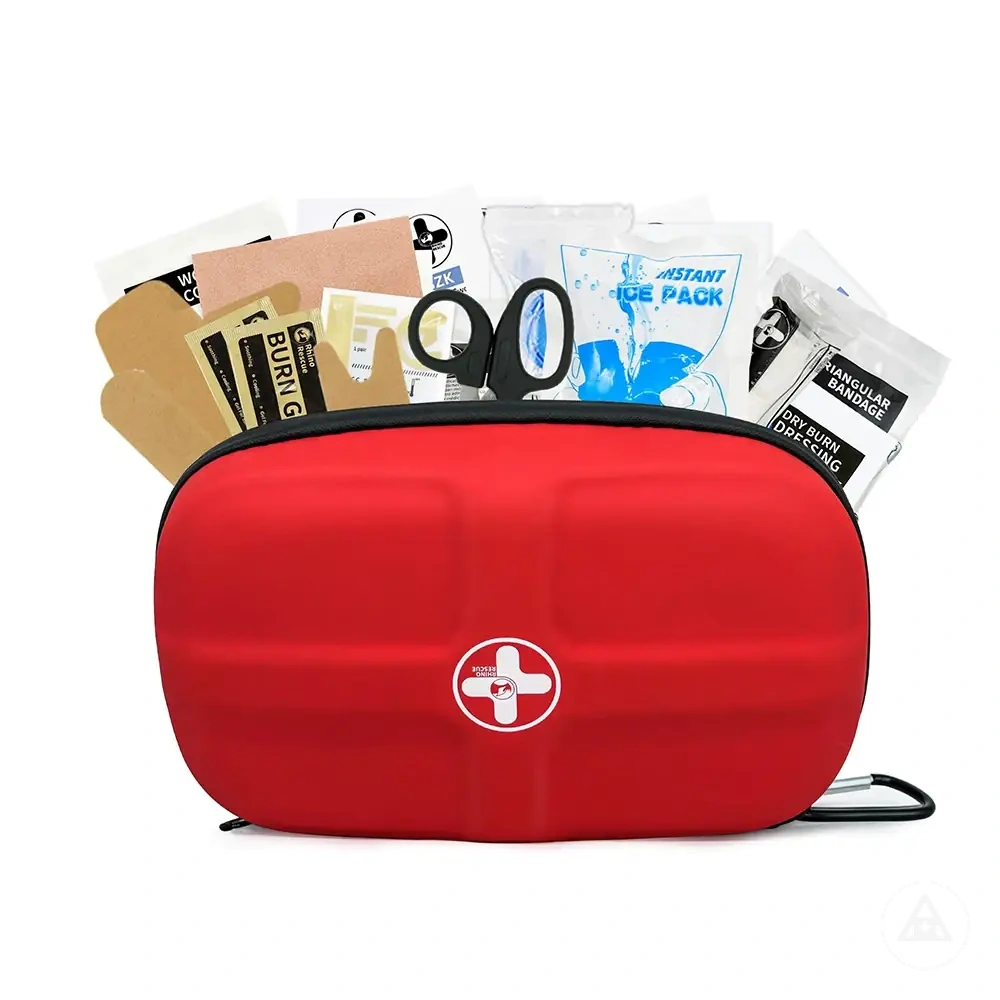
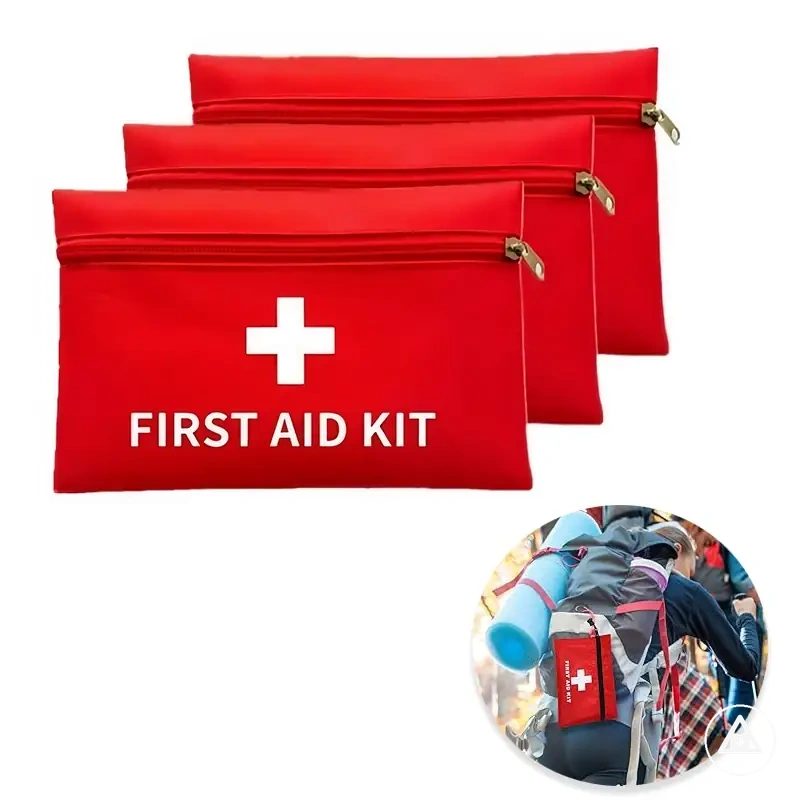
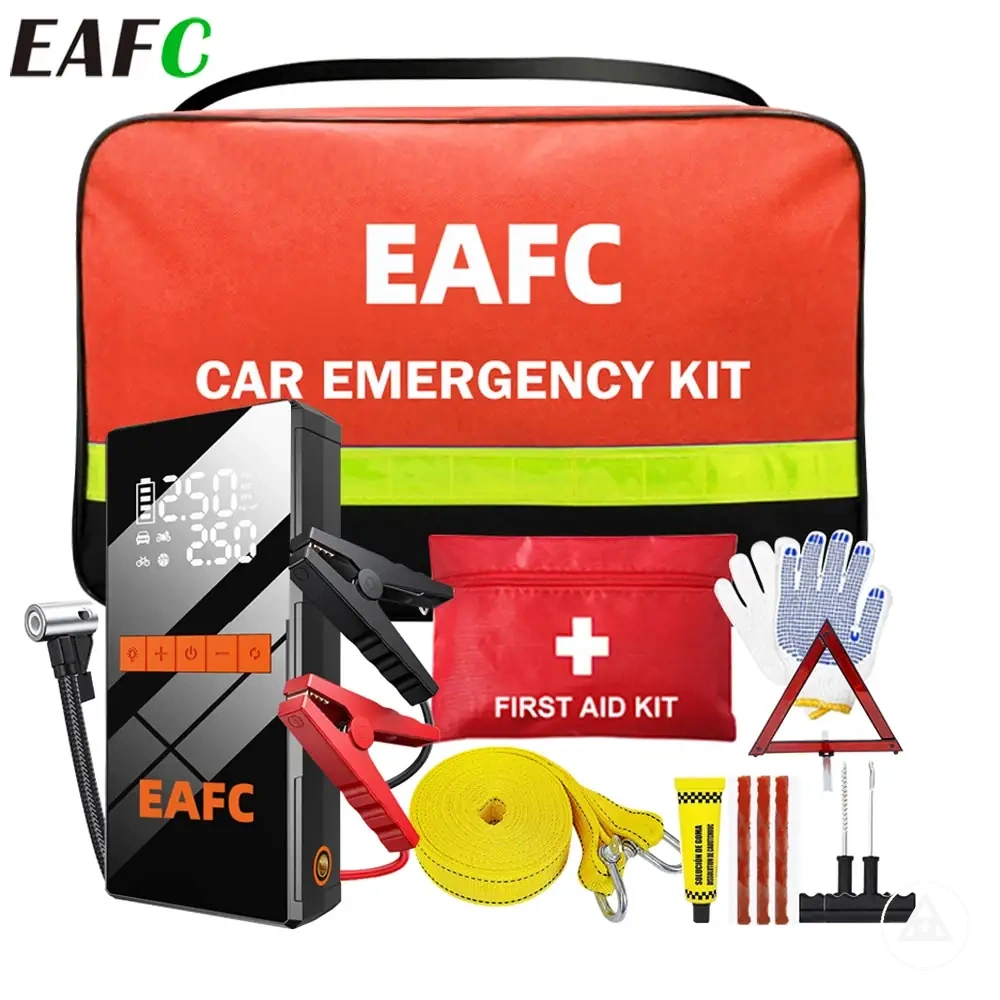
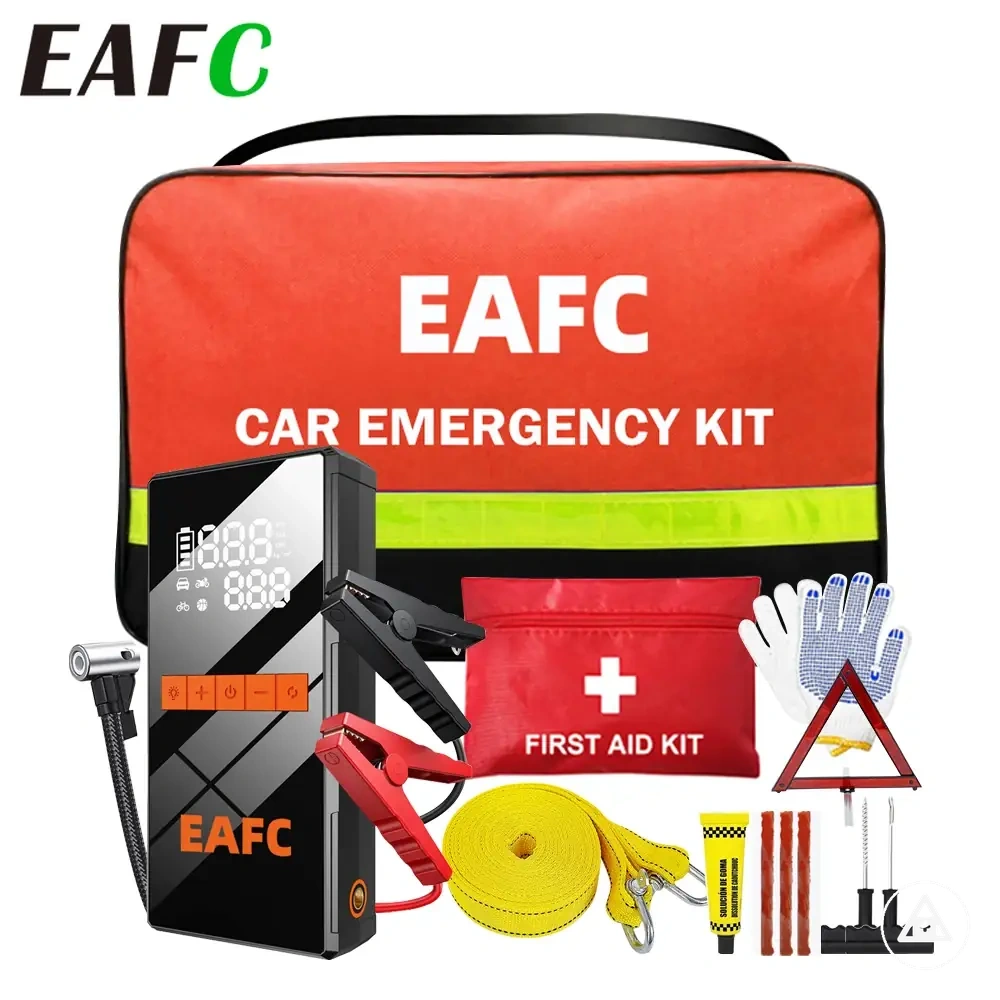
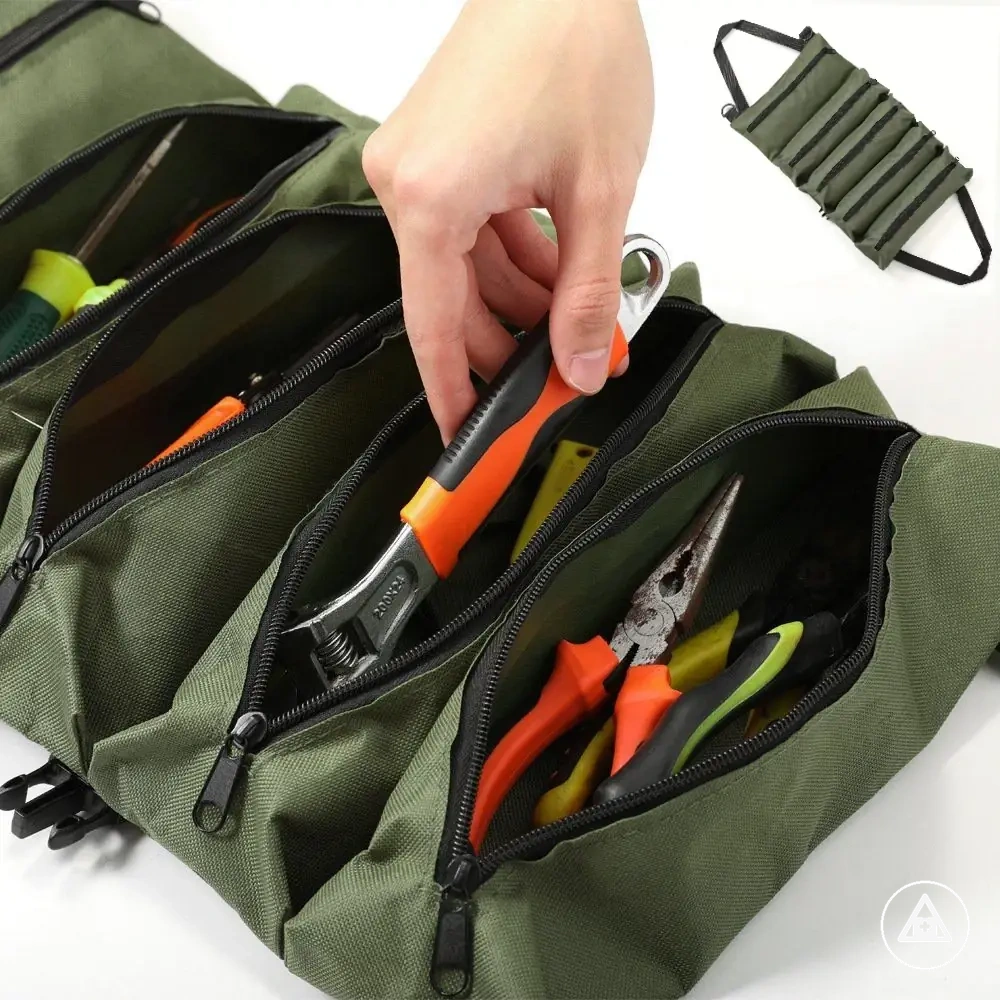
Here are product examples that may make comparison easier. Before buying, always review the compatibility criteria, essential features, and product details.
Piece count versus useful roadside coverage
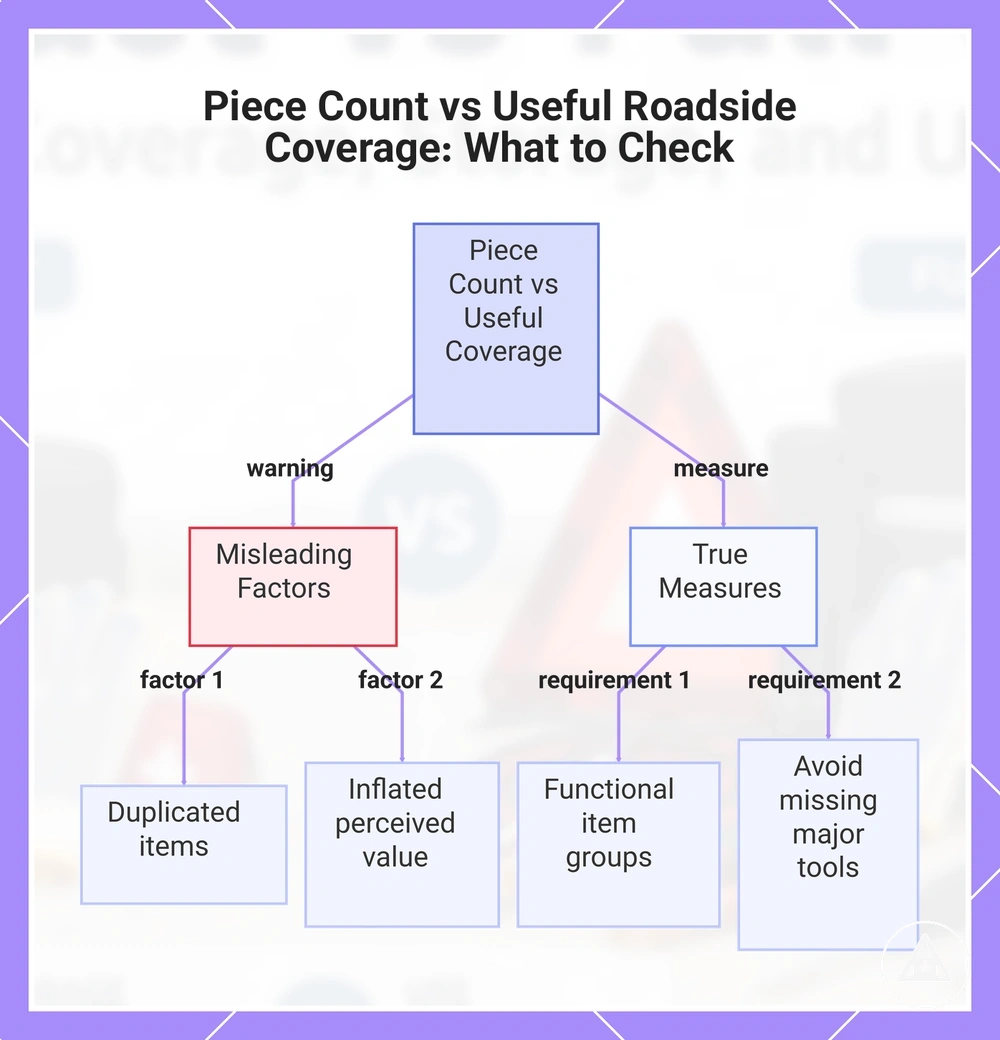
Piece count is not the same as useful roadside coverage because item quantity can hide how well a car emergency kit supports real roadside needs. A high kit count may include functional item groups that improve coverage, or duplicated items that inflate perceived value without solving a coverage gap.
Useful roadside coverage depends on whether the compact kit or full kit includes meaningful functional item groups and avoids missing major tools for the intended use case. Extra pieces can support real usefulness when they add distinct roadside functions, but piece count becomes less informative when duplicated items replace practical coverage.
- Check whether the piece count represents functional item groups, not only small repeated accessories.
- Look for duplicated items that may increase perceived value without improving coverage.
- Identify missing major tools that could create a practical coverage gap.
- Judge real usefulness by roadside coverage needs rather than kit count alone.
This chart explains why piece count can be misleading and how to evaluate a car emergency kit's true roadside coverage.
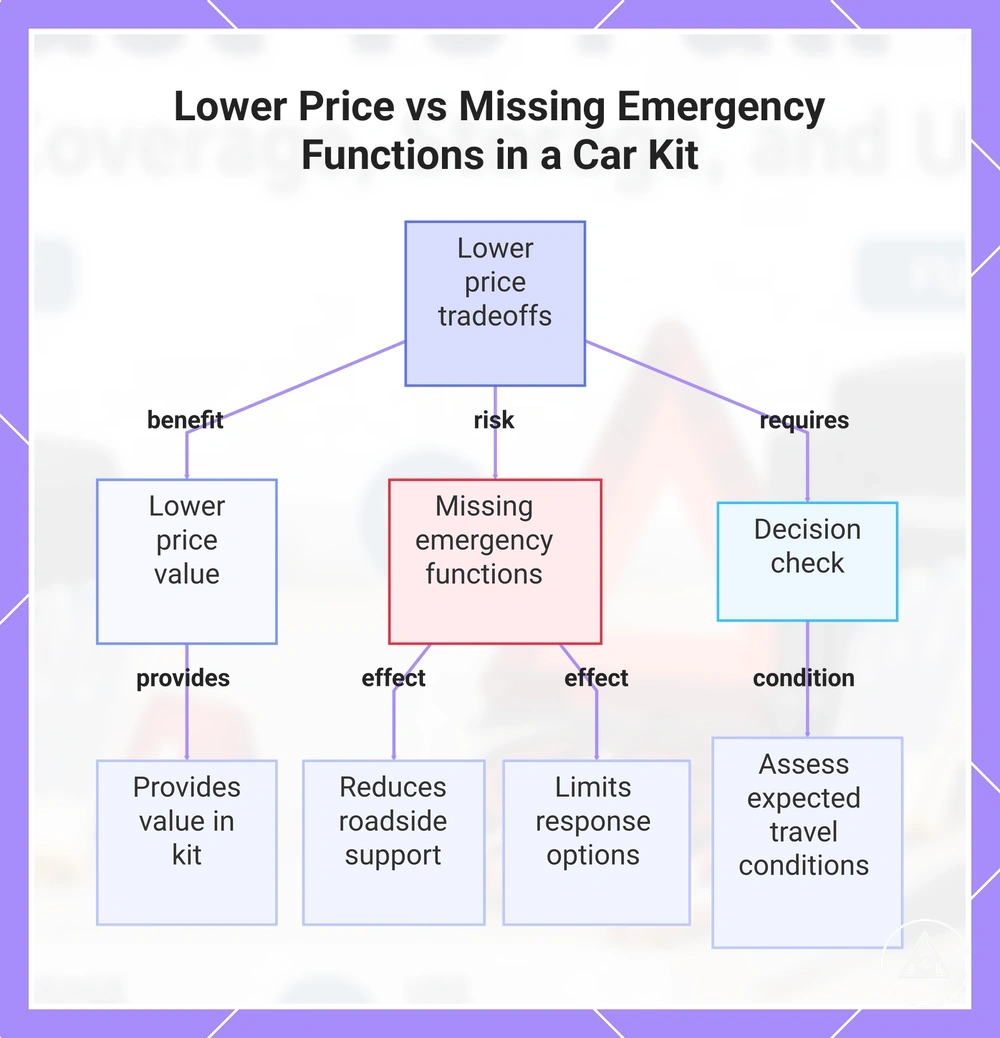
Lower price versus missing emergency functions
Lower price can provide value in a car emergency kit, but missing emergency functions may affect usefulness in specific roadside situations. A cheaper kit may rely on omitted tools, lighter materials, a smaller first aid range, or fewer comfort items, so the decision depends on whether those functions matter for the expected travel conditions.
Before choosing a lower-price option, check for function-related tradeoffs that may influence roadside coverage and risk:
- Omitted tools may reduce support for certain roadside situations.
- Lighter materials may affect long-term durability, although this varies by kit design.
- A smaller first aid range may provide fewer response options when needs extend beyond basic situations.
- Fewer comfort items may matter when waiting times are longer than expected.
- For example, a compact kit may cost less but still require checking whether an important roadside function has been omitted for the intended use case.
The most suitable decision depends on balancing lower price against the potential effect of missing emergency functions rather than focusing on cost alone.
This chart compares the tradeoffs between a lower price and missing emergency functions in a car emergency kit, showing the benefit of lower price, the risks of missing functions, and the decision check for expected travel conditions.
When compact or full coverage is the safer fit
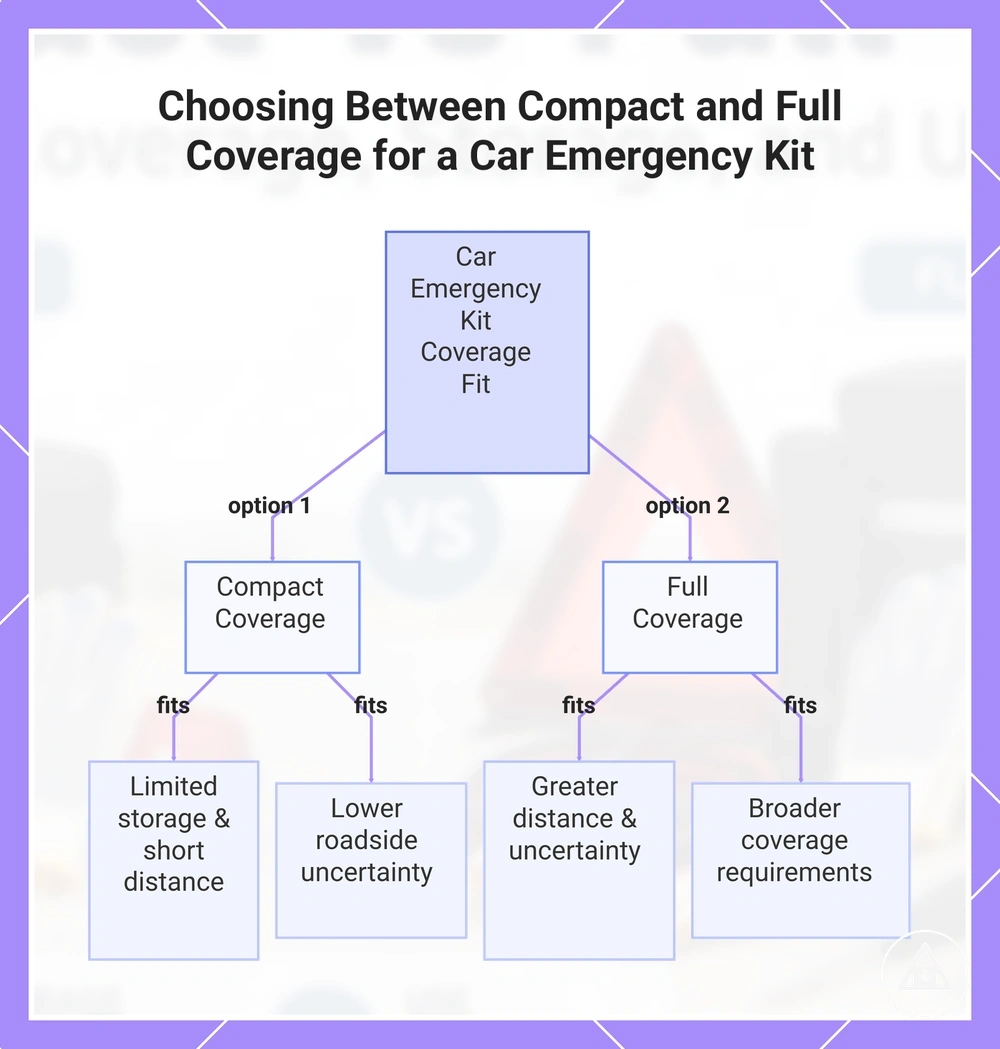
Compact or full coverage is the safer fit when the car emergency kit matches your coverage need, storage space, driving distance, and roadside uncertainty. The safer choice depends on the driver profile and the level of roadside support that may be needed during travel.
Compact coverage often fits a driver profile with limited storage space, shorter driving distance, and lower roadside uncertainty. A compact car emergency kit may provide enough coverage when daily driving conditions are relatively predictable and coverage requirements remain modest.
Full coverage often fits a driver profile with greater driving distance, broader coverage requirements, or higher roadside uncertainty. Full coverage may be a better fit when travel conditions increase the likelihood of needing additional roadside support.
The decision checklist below helps connect coverage requirements to the right kit size:
- Choose compact coverage when coverage need is relatively simple and storage space is limited.
- Consider full coverage when driving distance regularly increases exposure to roadside uncertainty.
- Review whether passenger needs may increase the desired coverage requirement.
- Consider broader coverage when weather conditions may affect roadside preparedness needs.
- Check whether existing vehicle tools already provide functions that reduce additional coverage requirements.
- Match the car emergency kit to expected travel conditions rather than selecting by size alone.
The final recommendation depends on balancing coverage need, storage space, driving distance, and roadside uncertainty against the driver profile. A compact or full coverage fit can be the safer choice when it aligns with the conditions most likely to be encountered.
Here are product examples that may make comparison easier. Before buying, always review the compatibility criteria, essential features, and product details.
This chart shows the driver profile conditions that determine whether compact or full coverage is the safer fit for a car emergency kit.
When a compact kit is enough
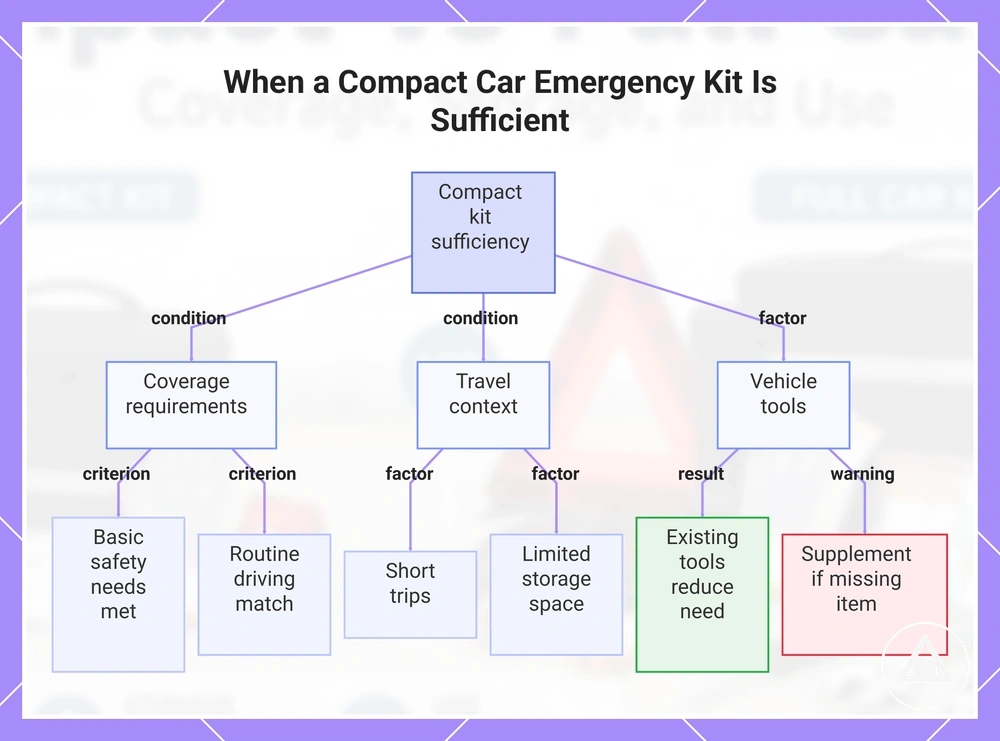
A compact kit is enough when the car emergency kit matches basic safety needs, available storage space, and expected travel conditions. Compact coverage can reasonably satisfy the driver's needs when coverage requirements remain limited and existing vehicle tools already support part of the coverage condition.
- Short trips can make a compact kit enough when roadside uncertainty remains relatively low.
- Limited space can favor compact coverage because larger storage requirements may not be practical.
- Basic safety needs can support a compact-fit decision when broader coverage is not expected.
- Existing vehicle tools can reduce additional coverage requirements and make a compact kit more suitable.
- A travel-size kit can be enough when the coverage condition matches routine driving needs.
A compact kit may need a supplement when a missing item changes the risk profile for a specific route or condition. The final decision depends on whether compact coverage continues to satisfy the expected coverage need after that missing function is considered.
This chart shows the key conditions that determine whether a compact car emergency kit is sufficient for a driver's needs.
When a full kit is the safer choice
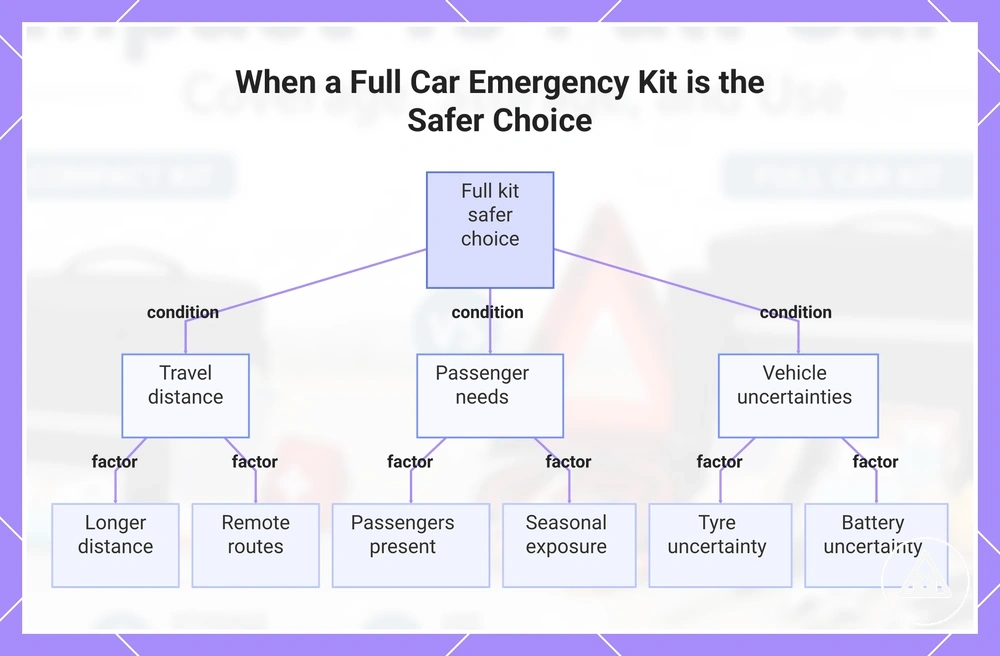
A full kit is the safer choice when the car emergency kit must support broader coverage needs created by travel conditions. Full coverage becomes more appropriate when longer distance, passengers, remote routes, seasonal exposure, tyre uncertainty, or battery uncertainty may increase the need for additional roadside support.
- Longer distance can favor a full kit because assistance may be less accessible during a roadside delay.
- Passengers can increase coverage needs because comfort and preparedness requirements may be greater.
- Remote routes can make fuller coverage more useful when roadside support may take longer to reach.
- Seasonal exposure can favor a broader kit because changing conditions may increase roadside needs.
- Tyre uncertainty can support a full-coverage decision when additional roadside tools may be useful.
- Battery uncertainty can justify broader coverage when starting issues may require additional support.
A full kit is most useful when its added items match real driving conditions rather than simply increasing item count. The final decision depends on whether broader coverage aligns with the conditions most likely to be encountered.
This chart shows the key conditions that make a full car emergency kit a safer choice, including travel distance, passenger needs, and vehicle uncertainties.