Car Emergency Kit Cost and Value
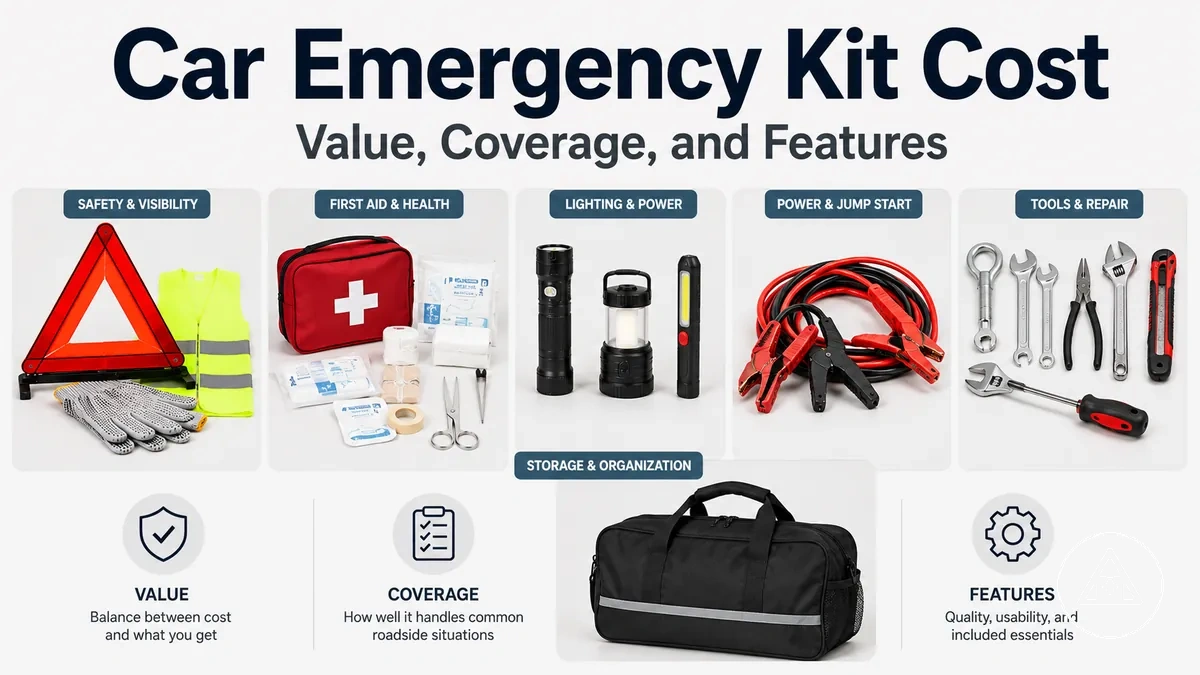
Car emergency kit cost reflects a value-and-coverage decision, not just a price range. A useful kit should connect kit contents, item quality, and roadside preparedness to the situations a driver may face. The right cost depends on whether the safety tools, first aid items, storage, and replacement needs support practical roadside coverage.
Item count, low price, or a large kit bundle can mislead value judgment when the included emergency supplies are weak, duplicated, hard to use, or poorly matched to the driving context. Price alone does not prove value, because item usefulness matters more than inflated contents. A roadside emergency kit may be better value when its coverage fits the vehicle use, distance, weather exposure, and likely replacement needs.
What Car Emergency Kit Cost Means for Roadside Coverage
Car emergency kit cost means paying for practical roadside coverage rather than simply adding more items to a bag. Roadside coverage reflects the types of situations a kit can help support during a breakdown or roadside delay. Car emergency kit cost and roadside coverage should be considered together because readiness depends on how well the kit addresses likely needs and limits. The goal is stronger roadside readiness through relevant coverage, not just a larger collection of supplies.
What Car Emergency Kit Cost Means for Roadside Coverage becomes easier to understand when coverage is viewed in groups rather than as individual items. The image below shows how cost can connect to roadside coverage categories that support different preparedness needs.
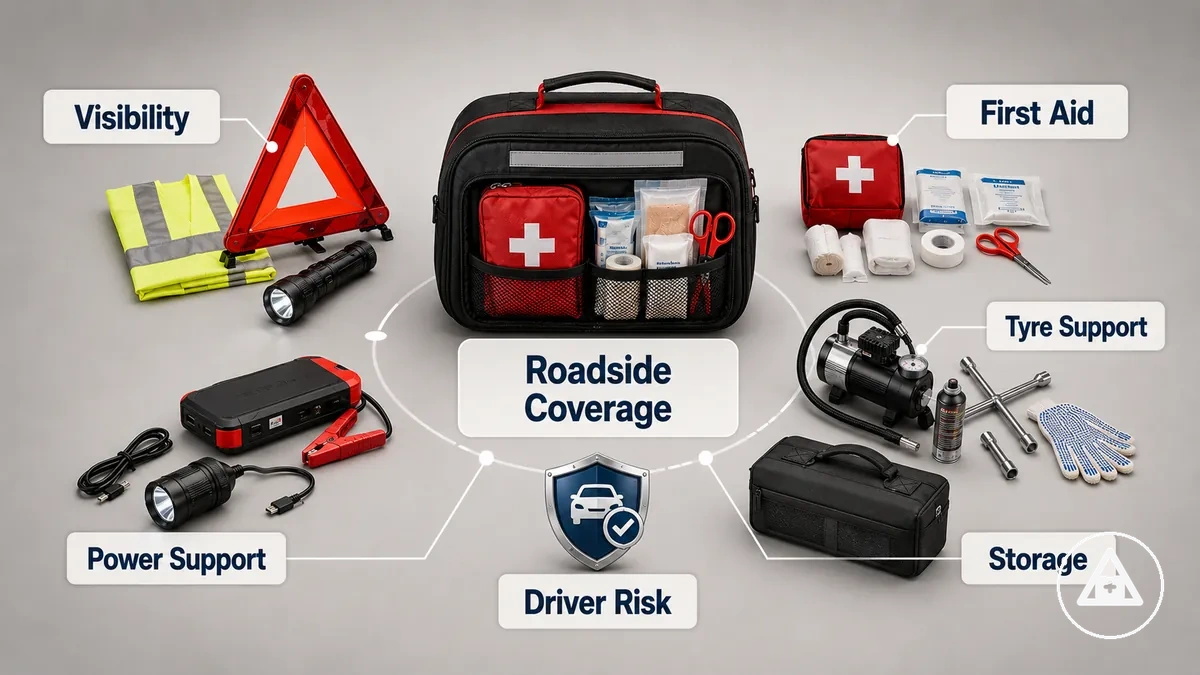
Roadside coverage can include visibility support for roadside safety, first aid resources for minor incidents, tyre support for common mobility problems, power support for battery-related situations, and storage that helps keep vehicle emergency supplies accessible and usable. The usefulness of these coverage areas depends on condition, maintenance, and readiness over time. Coverage that aligns with likely driving conditions can improve preparedness more effectively than coverage that addresses unlikely situations. As driver risk changes with distance, weather, and vehicle use, coverage needs may change as well.
A higher price does not automatically provide better roadside coverage if the added items have limited relevance to the intended use case. Better value often depends on whether the extra coverage supports real driver risk, readiness needs, and practical access during a breakdown. For broader context on how coverage categories fit into overall preparedness decisions, see the car emergency kit guide. Matching coverage to use case is usually more important than paying for additions that may never be needed.
Indicative Car Emergency Kit Price Ranges
Indicative price ranges should be treated as broad guidance rather than live prices or fixed market facts. Car emergency kit price is most useful when interpreted through cost tier, coverage level, and value limitations. The following structure supports a tier-based interpretation rather than a fixed-price expectation.
A low-cost kit may focus on basic coverage and simple visibility or storage items, while a mid-range kit may include broader support and improved item quality. Higher-cost kit tiers can indicate wider coverage, more durable components, or support for a greater range of roadside situations. Actual typical contents, storage format, and preparedness outcome can vary by design, quality, and intended use.
Indicative Car Emergency Kit Price Ranges are easier to understand when viewed as coverage tiers instead of fixed costs. The image below clarifies how indicative ranges may relate to coverage depth, item quality, and practical limitations.
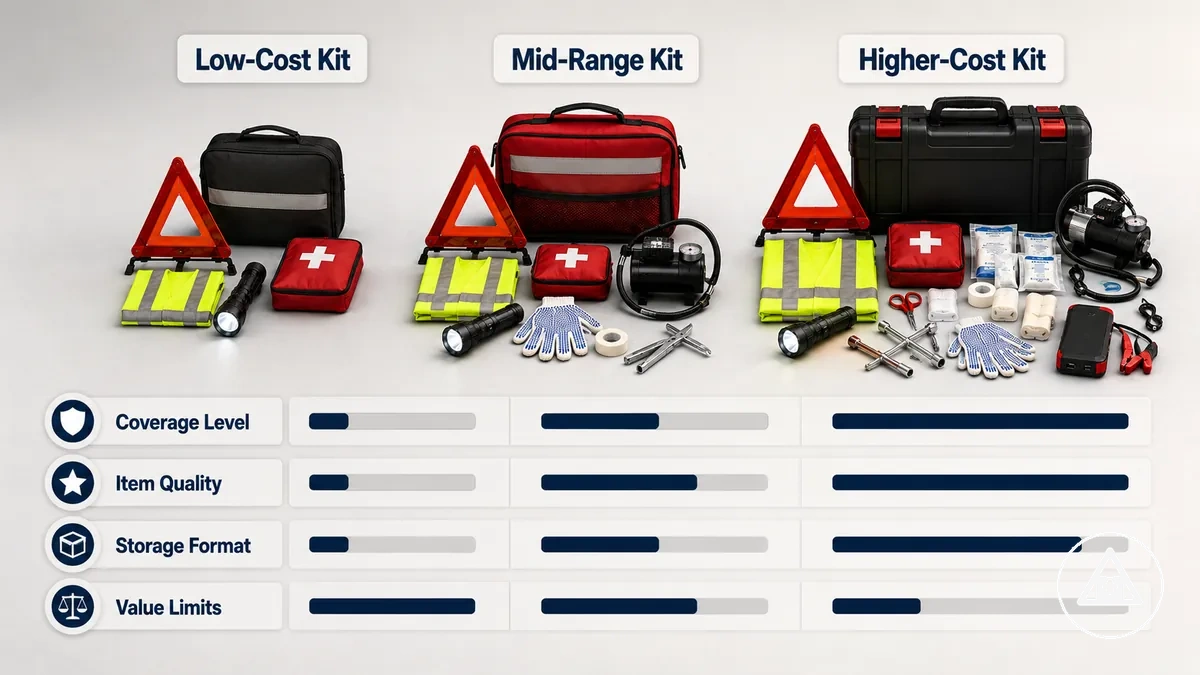
The table below organizes indicative price ranges by likely coverage level, typical value signals, and main limitations. It is intended to support interpretation rather than represent live prices.
| Kit range | Likely coverage level | Typical value signals | Main limitation |
|---|---|---|---|
| Low-cost kit | Basic coverage | Simple tools, visibility support, compact storage format | May provide limited preparedness for broader roadside situations |
| Mid-range kit | Moderate coverage | Broader tools, first aid support, improved item quality | Coverage depth may still depend on driving conditions and needs |
| Higher-cost kit | Extended coverage | More durable components, wider preparedness focus, larger storage format | Added contents may have limited value when they do not match the intended use case |
Using car emergency kit price as the only decision factor can create a mismatch between cost tier and practical coverage needs. Comparing coverage level, typical contents, item quality, storage format, and value limitations often provides a clearer picture of suitability. The strongest value signal is whether the kit tier supports the intended preparedness outcome.
Low-Cost Kits and Basic Coverage
A low-cost kit can be useful for basic roadside readiness when expectations are limited. Basic coverage often focuses on common roadside needs rather than broader emergency support. A low-cost kit can provide practical value when low-risk driving conditions and expected roadside needs remain relatively simple.
Low-Cost Kits and Basic Coverage are easier to understand when viewed as practical coverage variables rather than item count alone. The image below illustrates typical basic coverage without implying that every low-cost kit includes the same items.
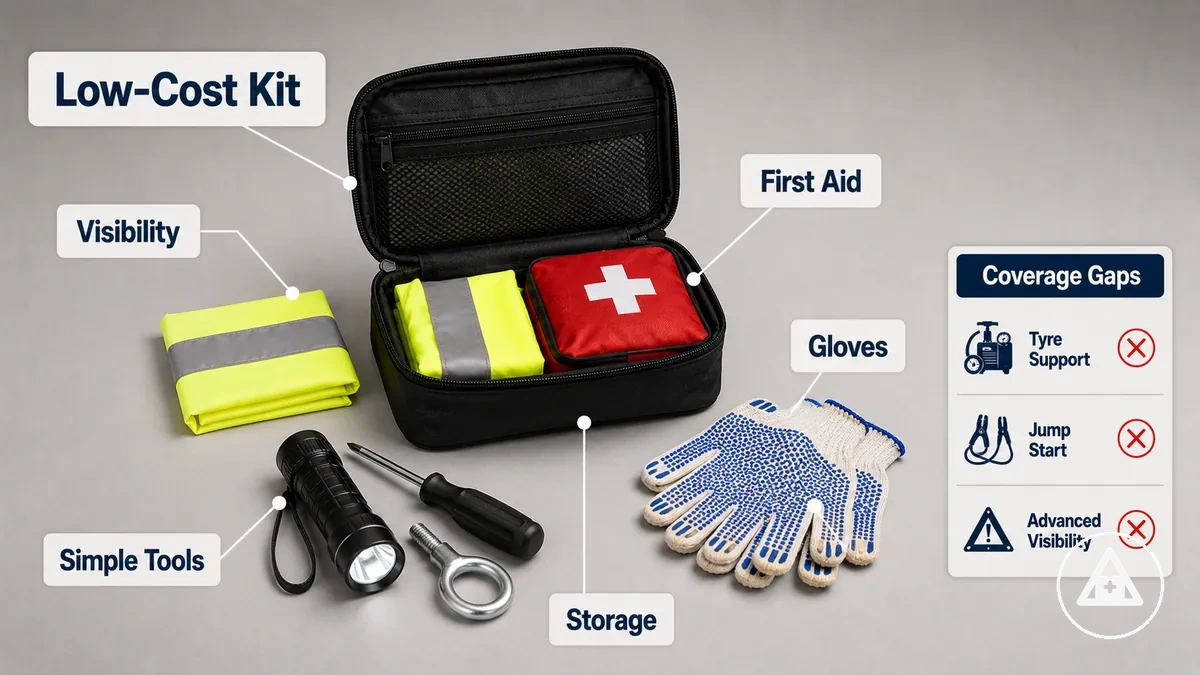
A low-cost kit may include visibility items, basic first aid supplies, gloves, simple tools, and compact storage that keeps essential equipment accessible. Coverage gaps may appear when item quality, tool depth, or roadside requirements extend beyond routine situations. A budget kit can still support common roadside needs, but adequacy depends on driving conditions, expected use, and the type of event encountered. Realistic limits are easier to manage when a basic roadside kit is matched to low-risk driving and straightforward roadside needs.
Mid-Range Kits and Broader Roadside Tools
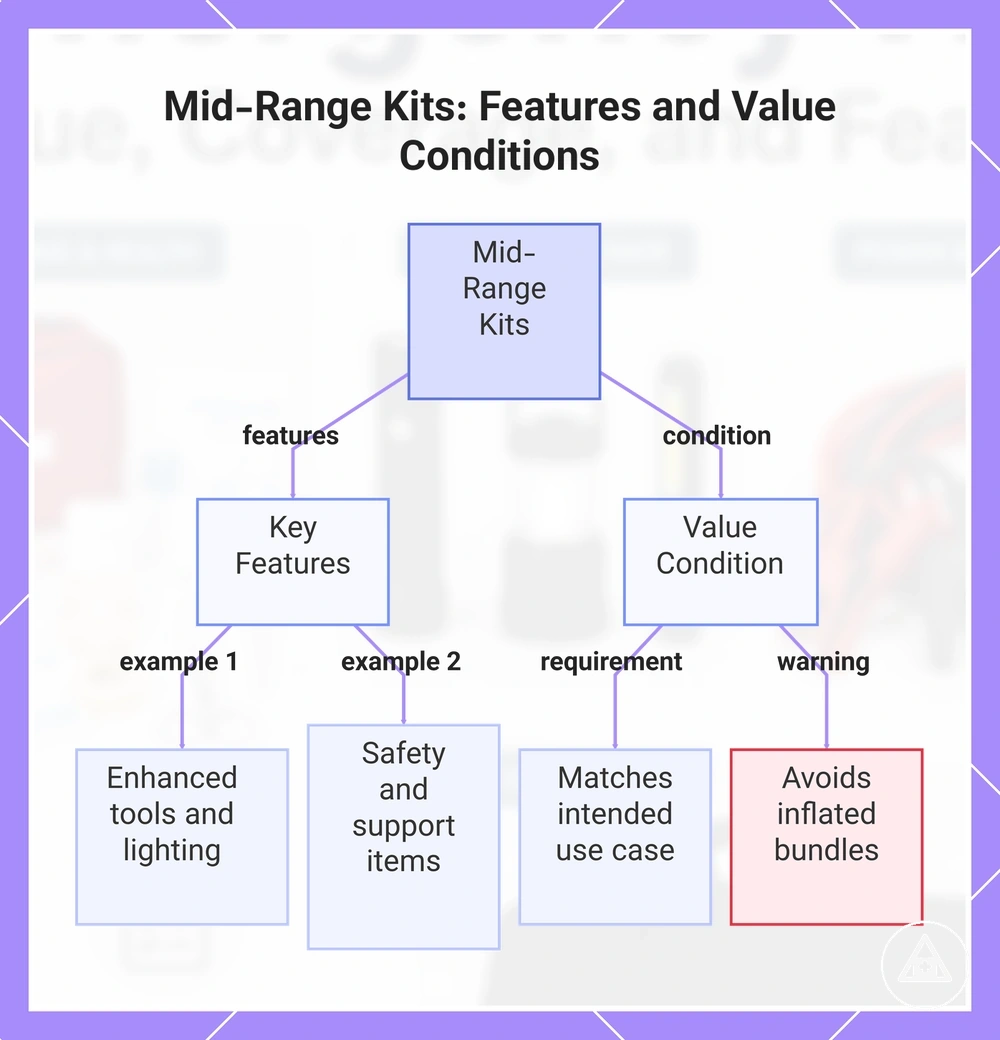
Mid-range kits usually add broader roadside capability when the added tools are relevant to expected driving conditions and roadside needs. A mid-range kit may extend support beyond basic coverage by adding resources that improve preparedness in a wider range of situations. Value gain depends on whether the added capability matches the intended use case.
Mid-range kits can broaden preparedness through greater tool depth, improved lighting, more visible warning equipment, higher first aid quality, tyre-related support, and stronger storage durability. These features may improve practical capability when they address likely roadside needs rather than simply increasing item count. A middle-tier kit can justify added cost when broader roadside tools improve access, visibility, or preparedness for the driver's situation. Useful additions create value gain when they match the use case, while inflated bundles may add items without meaningfully expanding capability.
This chart shows the key features of mid-range kits and the conditions under which they provide value.
Higher-Cost Kits and Complete Safety Coverage
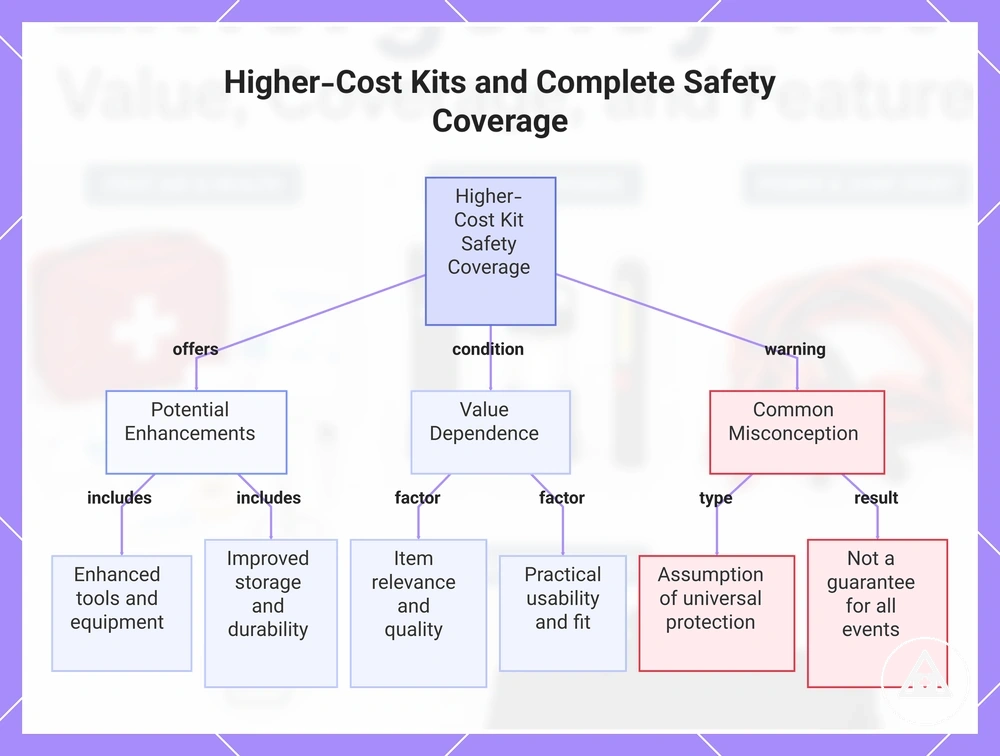
Higher-cost kits may add broader coverage when the included items match realistic roadside risks and preparedness needs. A higher-cost kit can support complete safety coverage through stronger roadside tools, broader safety equipment, better storage, and more durable components. The value of added coverage depends on item relevance, quality, and practical usability rather than cost alone.
A common assumption is that complete safety coverage means protection in every situation, but broader coverage does not guarantee support for every roadside event. A higher-tier kit may improve multi-scenario preparedness when stronger roadside tools, broader safety equipment, durable components, and better storage align with likely needs and conditions. These additions can support preparedness, yet their usefulness still depends on relevance, quality, and how they fit the intended use case. Price alone does not prove quality, so a higher-cost kit should justify its value through practical capability rather than kit size.
This chart shows what higher-cost kits can offer for safety coverage and why their value depends on relevance and usability, not just cost.
Main Factors That Change Car Emergency Kit Value
Main Factors That Change Car Emergency Kit Value depend on whether kit contents improve useful coverage, durability, usability, and fit for the driver. Value changes when a feature or component supports realistic roadside needs rather than simply increasing the number of items. Evaluating value through clear criteria creates a more reliable decision outcome than relying on price alone.
Differences in kit contents, item quality, coverage depth, and fit for driving conditions can produce different levels of usefulness. A component that improves durability or usability may add value when it addresses a genuine preparedness need, while a similar component may have less impact in another use case. Coverage depth can affect preparedness by reducing relevant coverage gaps, and driving fit depends on factors such as exposure, travel frequency, and expected conditions. This relationship between feature, attribute, value condition, and decision outcome provides a practical EAV evaluation framework.
Main Factors That Change Car Emergency Kit Value can be organized by linking each factor to its value effect. The table below maps each feature or component to the attribute being evaluated and its potential decision outcome.
| Feature or component | Attribute to evaluate | Value condition | Decision effect |
|---|---|---|---|
| Kit contents | Usability | Supports likely roadside needs | May improve preparedness |
| Item quality | Durability | Maintains usefulness during expected use | Can strengthen long-term value |
| Coverage depth | Preparedness | Addresses relevant coverage gaps | May broaden roadside capability |
| Storage | Access and portability | Keeps equipment organized and accessible | Can improve usability |
| Driving fit | Use case relevance | Matches driving conditions and exposure | May support a better decision outcome |
Evaluating features that affect value through coverage, quality, usability, and driving fit helps connect each factor to a practical decision outcome without relying on brand, SKU, or merchant claims.
Number and Quality of Included Items
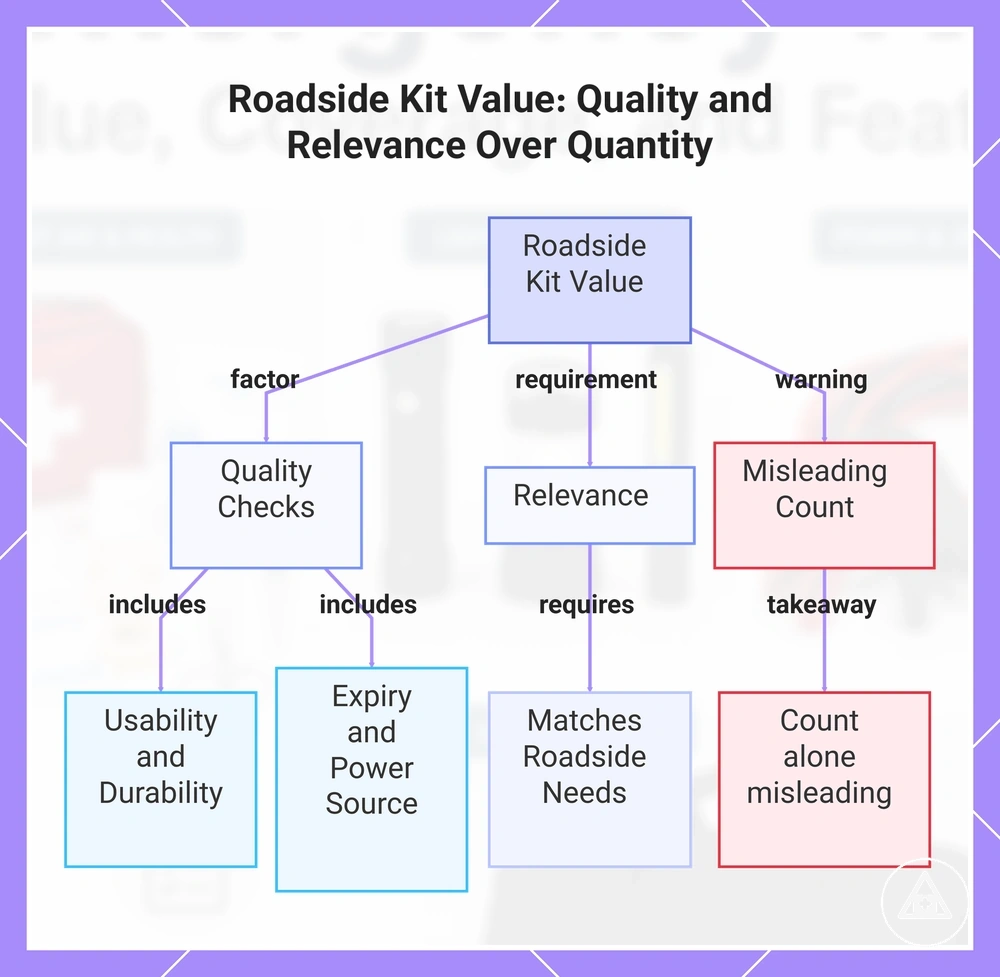
More items do not always mean better value. Item count improves value when the included items contribute to real roadside usefulness rather than increasing quantity alone. Value depends on the connection between item count, relevance, and quality.
A common myth is that a higher item count automatically creates a better kit, but the more useful measure is whether included items remain relevant, usable, and durable when needed. Quality checks can include usability during roadside situations, material strength that supports durability, expiry considerations for time-sensitive supplies, and power source readiness for battery-dependent items. An included item may add value when it supports a realistic roadside need and remains functional in expected conditions. Item count alone can be misleading when additional items contribute little practical roadside usefulness.
- Usability: Included items should be practical and accessible during roadside use.
- Durability: Material strength and condition can affect long-term usefulness.
- Expiry: Time-sensitive supplies may require replacement to maintain readiness.
- Power source: Battery-dependent items may depend on functional batteries or other power sources.
- Relevance: Included items should match likely roadside needs rather than increase quantity without purpose.
This chart shows the key factors that determine the true value of included items in a roadside emergency kit, emphasizing that item count alone is misleading.
Safety, First Aid, and Roadside Tool Coverage
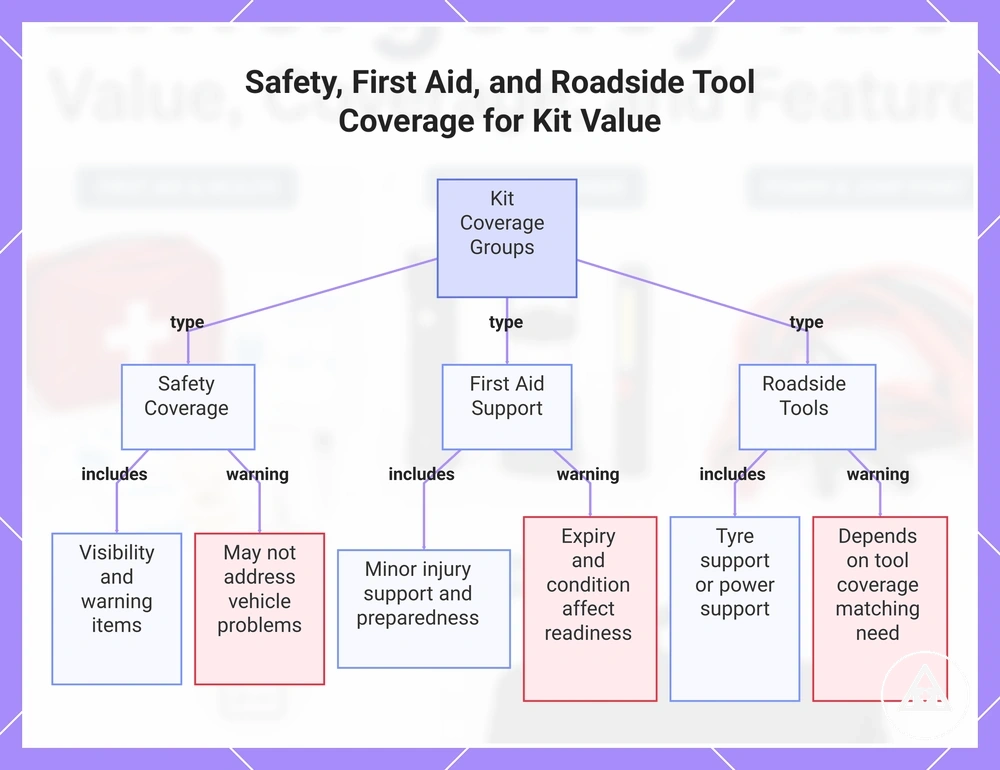
Safety coverage, first aid, and roadside tools are the three coverage groups that influence practical kit value. Safety coverage supports visibility and warning items, first aid supports minor injury support and readiness, and roadside tools support common roadside assistance needs. Each group serves a different emergency function and carries its own limitation and decision relevance. Practical value depends on maintaining a balance across all three coverage groups.
- Safety and visibility: Safety coverage supports visibility through warning items that can help highlight roadside risk. Its limitation is that warning items alone may not address vehicle-related problems. The value signal is improved awareness during roadside situations.
- First aid support: First aid supplies support minor injury support and preparedness when basic assistance may be needed. A limitation is that expiry and condition can affect readiness over time. The value signal is broader preparedness for minor incidents without implying treatment outcomes.
- Roadside tools: Roadside tools support functions such as tyre support or power support when common roadside issues occur. Their limitation depends on whether tool coverage matches the actual need. The value signal is greater roadside usefulness when the tools align with likely situations.
Weak coverage in any one group can reduce practical value even when the other groups are well represented. Strong visibility with limited first aid support, or useful roadside tools with weak warning items, may leave gaps that affect decision relevance. The most useful balance depends on likely roadside needs, expected conditions, and the type of roadside risk a driver may encounter.
This chart shows the three coverage groups that influence practical kit value, including their functions and limitations.
Storage Bag Quality and Portability
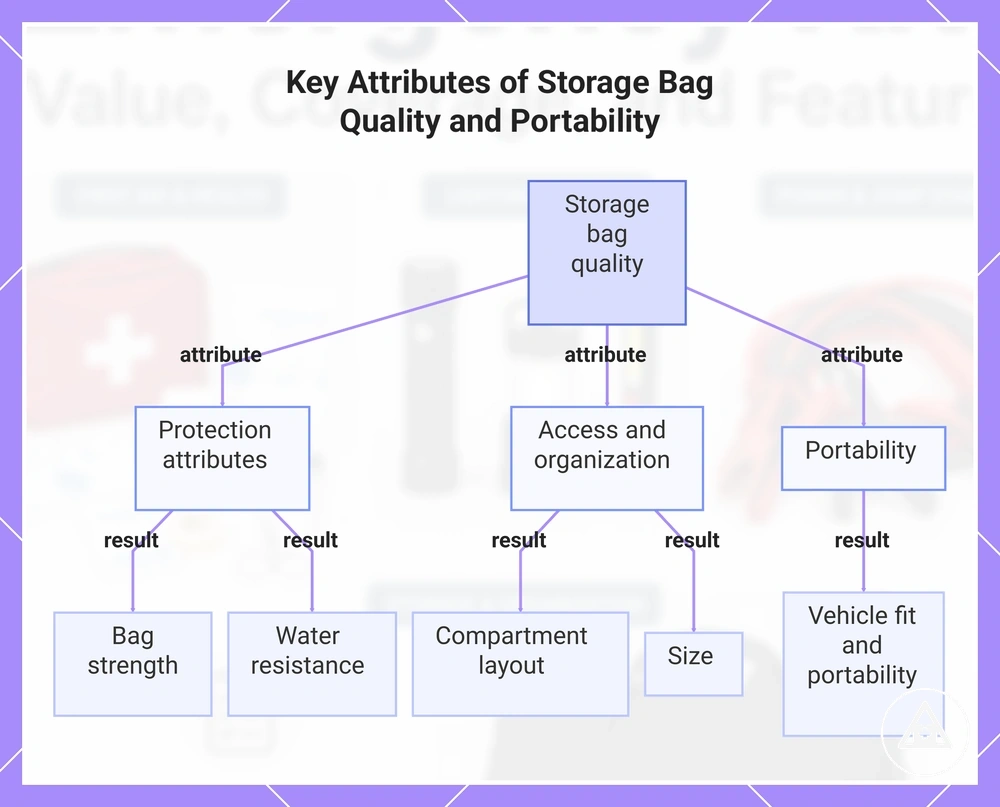
Storage bag quality affects whether the kit stays usable and accessible when needed. A storage bag that supports access and protects included items can improve durability and day-to-day readiness. This relationship directly influences overall usefulness.
Weak bag strength, limited compartment layout, or an unsuitable size can reduce access and make equipment harder to organize. A stronger storage case may help protect contents from wear, while a practical compartment layout can support faster access to important items. Water resistance may help reduce moisture exposure in certain conditions, and portability depends on how well the storage bag balances size with vehicle fit. These attributes support protection, convenience, and readiness, but storage remains a value attribute within the broader assessment of overall kit usefulness.
- Bag strength: May support durability by helping the storage bag withstand regular use.
- Compartment layout: Can improve access by keeping items organized and easier to locate.
- Water resistance: May help protect contents from moisture depending on bag condition and environment.
- Size: Affects how efficiently the storage bag accommodates kit contents without unnecessary bulk.
- Vehicle fit and portability: Can support convenience when the storage bag fits available space and remains easy to handle.
This chart shows the main attributes that affect storage bag quality and portability.
Ongoing Refill and Replacement Costs
Ongoing refill costs and replacement costs are part of total kit value because readiness depends on keeping key items usable over time. The initial purchase price is only one part of the cost picture, while consumables, expiring items, and replacement supplies can affect long-term usefulness. Planning for kit upkeep helps maintain readiness.
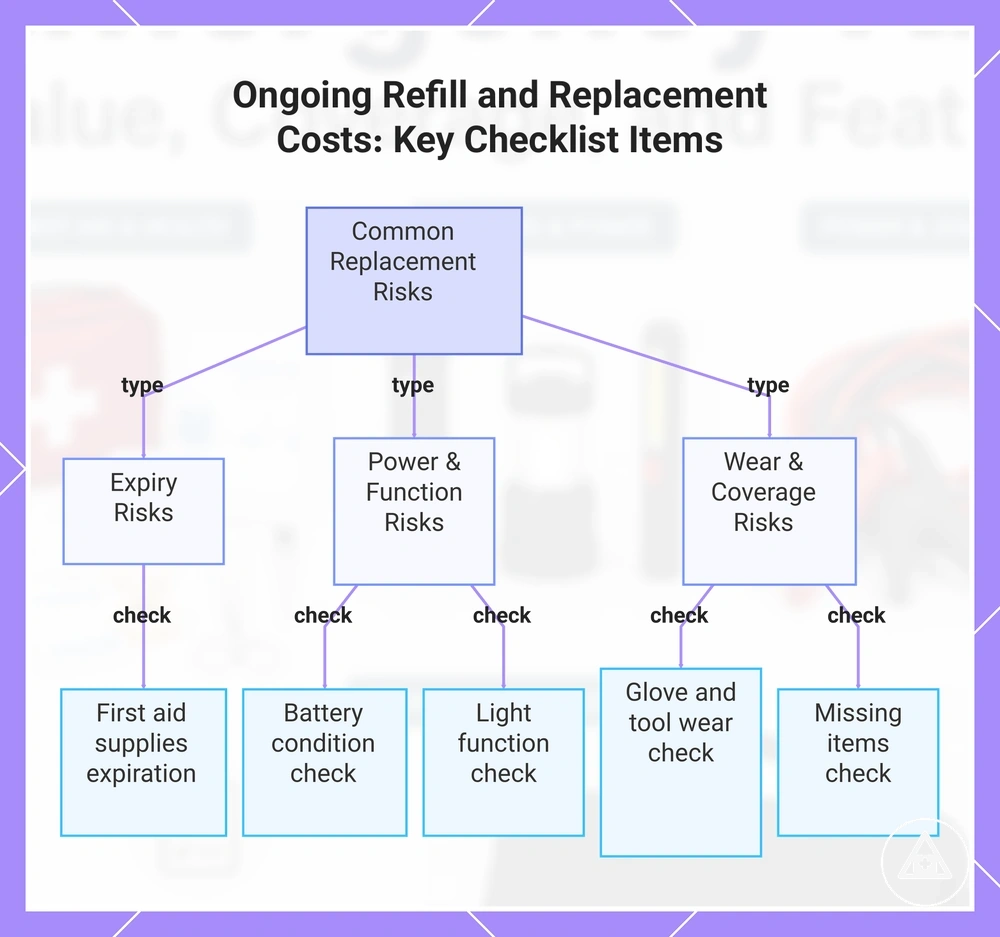
Consumables and expiring items may need replacement when condition, expiry, or usability changes. Batteries can drain, lights may stop functioning as expected, gloves can wear over time, and damaged tools can reduce preparedness when they are no longer usable. Missing items can also create coverage gaps that affect readiness and may increase replacement costs. These condition-based cost effects vary by use, storage conditions, and how often replacement needs occur.
A lower-priced kit may appear to offer stronger value at first, but that value can decrease when refills are frequent or replacement supplies are difficult to source. Ongoing Refill and Replacement Costs can be reviewed through a simple checklist that verifies common replacement-related value risks.
- First aid supplies: Check for expiring items that may affect readiness when replacement is needed.
- Batteries: Review battery condition because drained power sources can reduce usefulness.
- Lights: Verify light function to identify potential replacement costs related to power or wear.
- Gloves and damaged tools: Check for wear, damage, or reduced usability that may affect preparedness.
- Missing items: Confirm that essential components remain present to avoid coverage gaps and restocking costs.
This chart shows the main categories of replacement-related value risks to check in a kit, based on common expiring, draining, and wearing items.
Pre-Made and DIY Kit Cost Tradeoffs
Pre-made kit and DIY kit cost tradeoffs depend on convenience, customization, replacement control, and potential coverage gaps rather than price alone. A pre-made kit trades item control for convenience, while a DIY kit trades convenience for greater customization. The comparison is most useful when evaluated through cost-value reasoning rather than upfront cost alone.
Upfront cost is only one part of the decision because time required, completeness, item control, and replacement control can also influence value outcome. A pre-made kit may provide faster access to a more complete setup, but completeness can vary and certain items may not match specific priorities. A DIY kit allows greater customization and replacement control, yet building and maintaining coverage may require more time and planning. Both approaches can leave coverage gaps when important items are overlooked or when kit contents do not align with expected needs. The better fit depends on buyer priorities, preparedness goals, and the preferred balance between convenience and control.
Pre-Made and DIY Kit Cost Tradeoffs can be compared by examining how each kit path affects cost advantage, value limitation, and decision fit. The table below compares these cost tradeoffs without identifying a universal winner.
| Kit path | Cost advantage | Value limitation | Better fit when |
|---|---|---|---|
| Pre-made kit | May reduce setup time and provide immediate completeness | Can offer less customization and limited item control | Convenience and quicker readiness are higher priorities |
| DIY kit | May provide stronger customization and replacement control | Often requires more time and attention to avoid coverage gaps | Item control and tailored coverage are higher priorities |
For a broader comparison of pre-made versus DIY value, consider how convenience, completeness, customization, and replacement control can influence the final value outcome under different conditions.
Compact and Full Kit Value Tradeoffs
Compact and full kits trade coverage against storage space and portability, making kit size a value decision rather than a simple size preference. A compact kit often prioritizes portability and efficient storage, while a full kit may broaden coverage depth with greater storage demand. Practical fit depends on driving risk, available space, and expected roadside needs.
A compact kit can provide useful value when storage space is limited or driving conditions involve lower exposure to extended roadside situations. Its smaller size may improve portability and make the kit easier to keep accessible inside the vehicle. Coverage gaps can appear if the compact kit excludes items that become relevant in less predictable situations. This path often fits best when limited space and lower driving risk are the primary conditions.
A full kit can provide broader coverage depth by allowing more roadside tools, safety items, and replacement supplies. This wider coverage may support preparedness when driving exposure increases or roadside assistance may be less accessible. The trade-off is that a full kit usually requires more storage space and can reduce portability. Its value often improves when broader coverage justifies the additional storage demand.
Compact and Full Kit Value Tradeoffs can be compared by evaluating kit size against coverage, storage demand, and practical fit. The table below organizes compact and full kit value by these decision criteria.
| Kit size | Value advantage | Trade-off | Better fit when |
|---|---|---|---|
| Compact kit | Higher portability and lower storage space demand | May have reduced coverage depth and more coverage gaps | Limited storage and lower driving risk are priorities |
| Full kit | Broader coverage depth and more roadside support options | Requires more storage space and can reduce portability | Greater driving risk or broader preparedness is desired |
Driving context can change the value outcome. City driving may favor a compact kit when roadside assistance is easier to access and storage space is limited. Long trips can increase the value of broader coverage, while remote-area exposure may justify additional roadside tools and supplies. The more suitable choice depends on how driving risk and storage constraints interact.
Practical fit comes from balancing kit size, coverage, portability, and storage demand rather than assuming one format is universally better. A compact kit and a full kit can both provide strong value when matched to the intended use case and expected conditions. For a broader comparison of compact and full kit tradeoffs, consider how coverage depth and storage requirements influence preparedness outcomes.
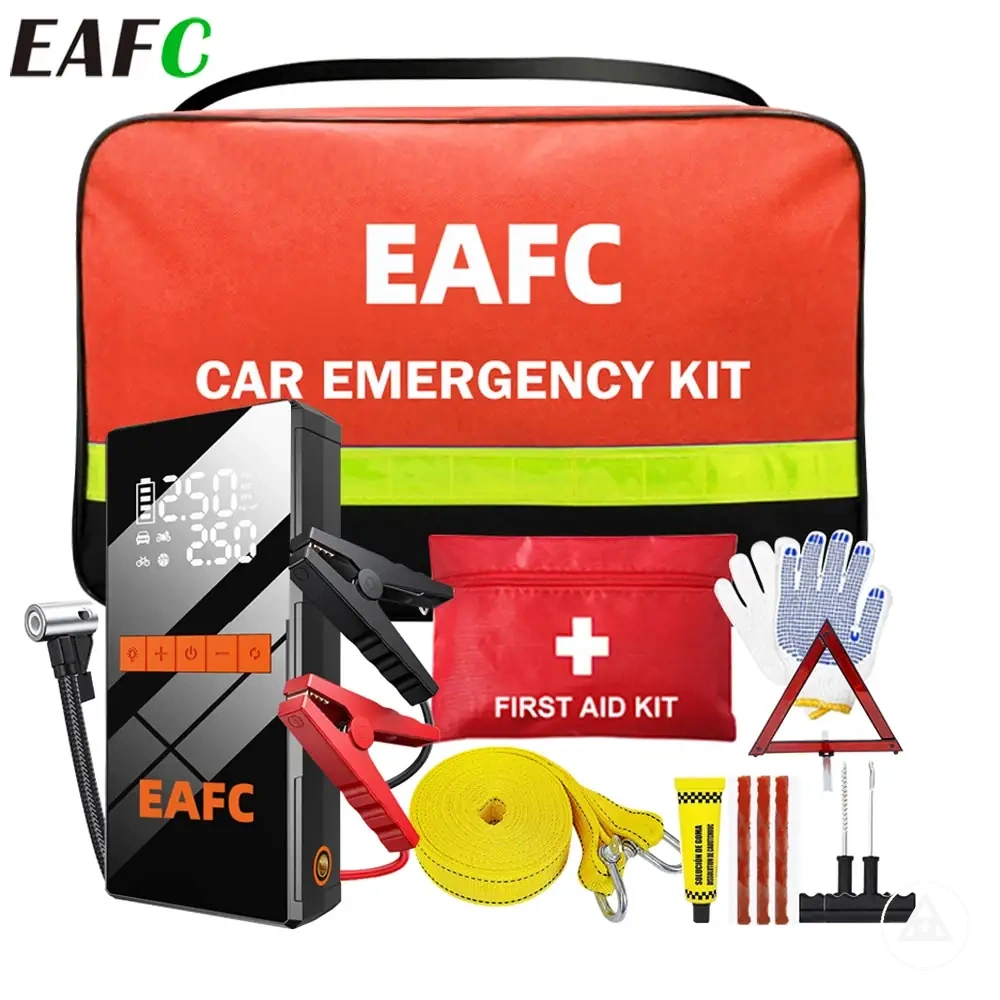
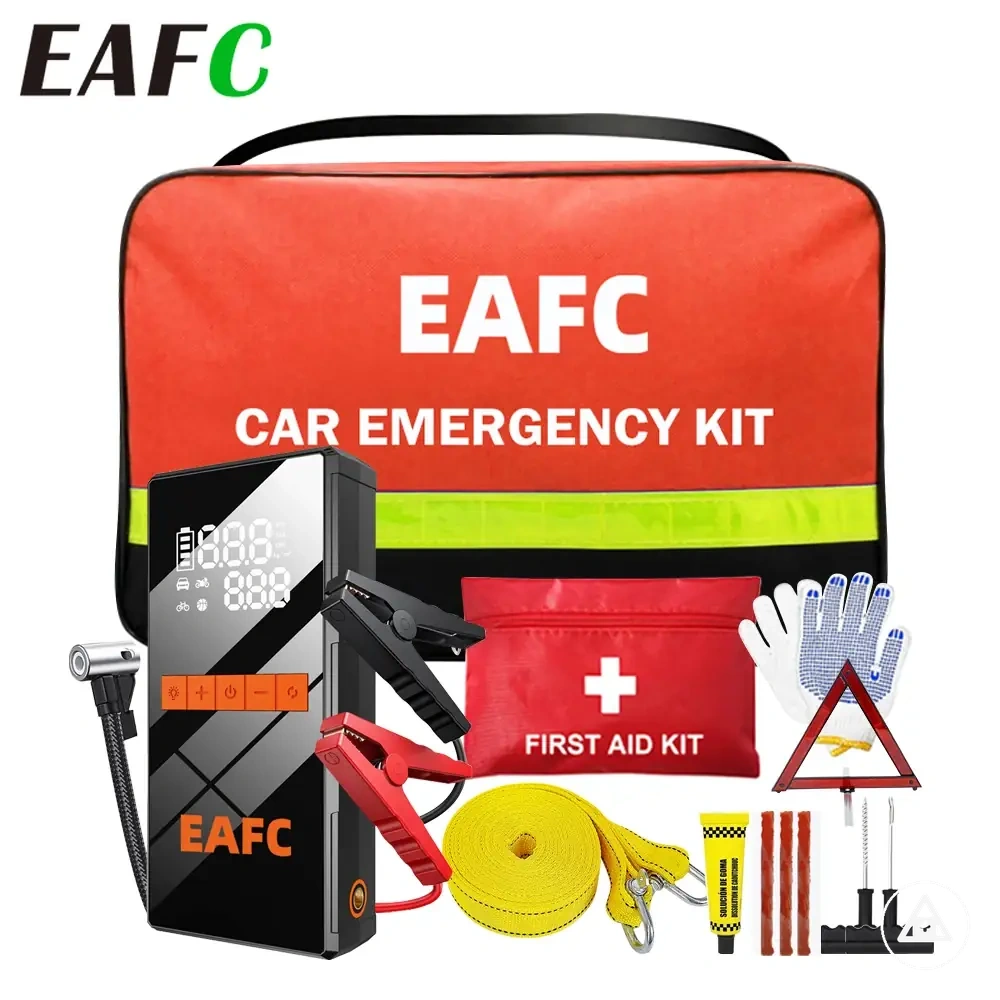
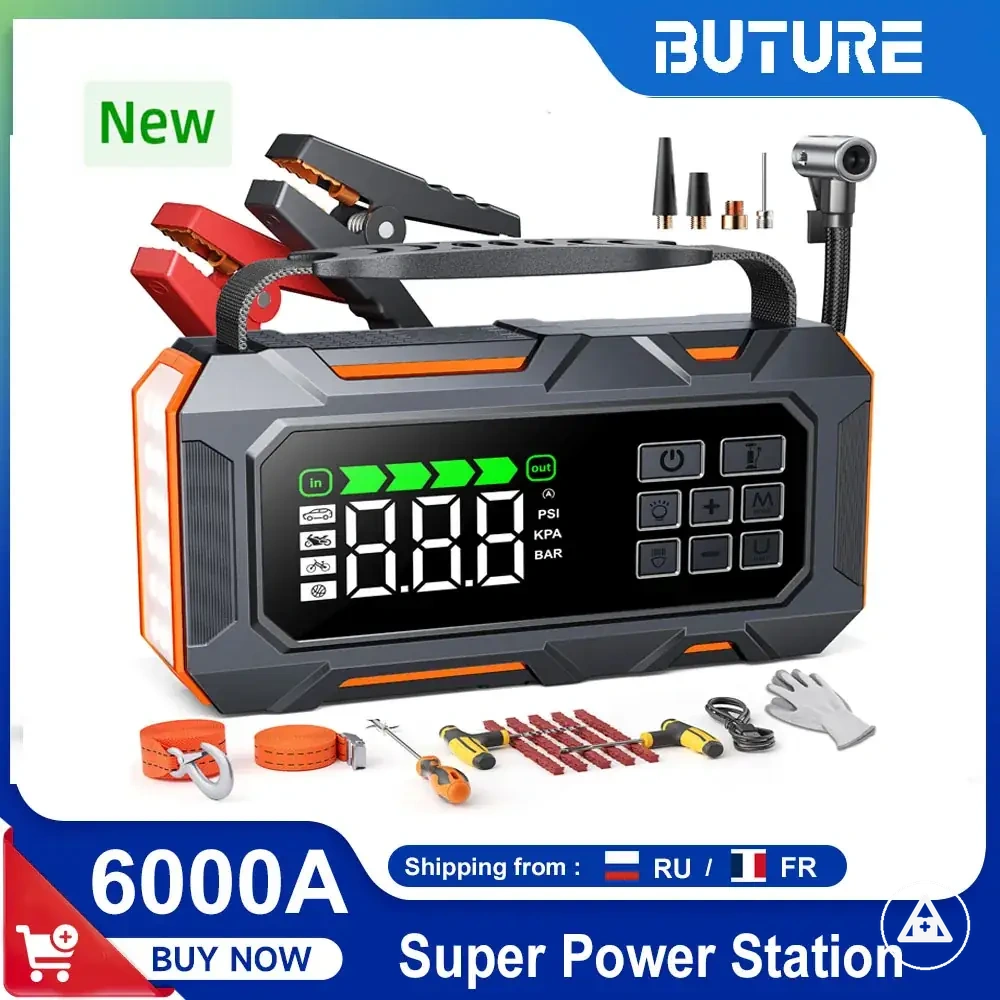
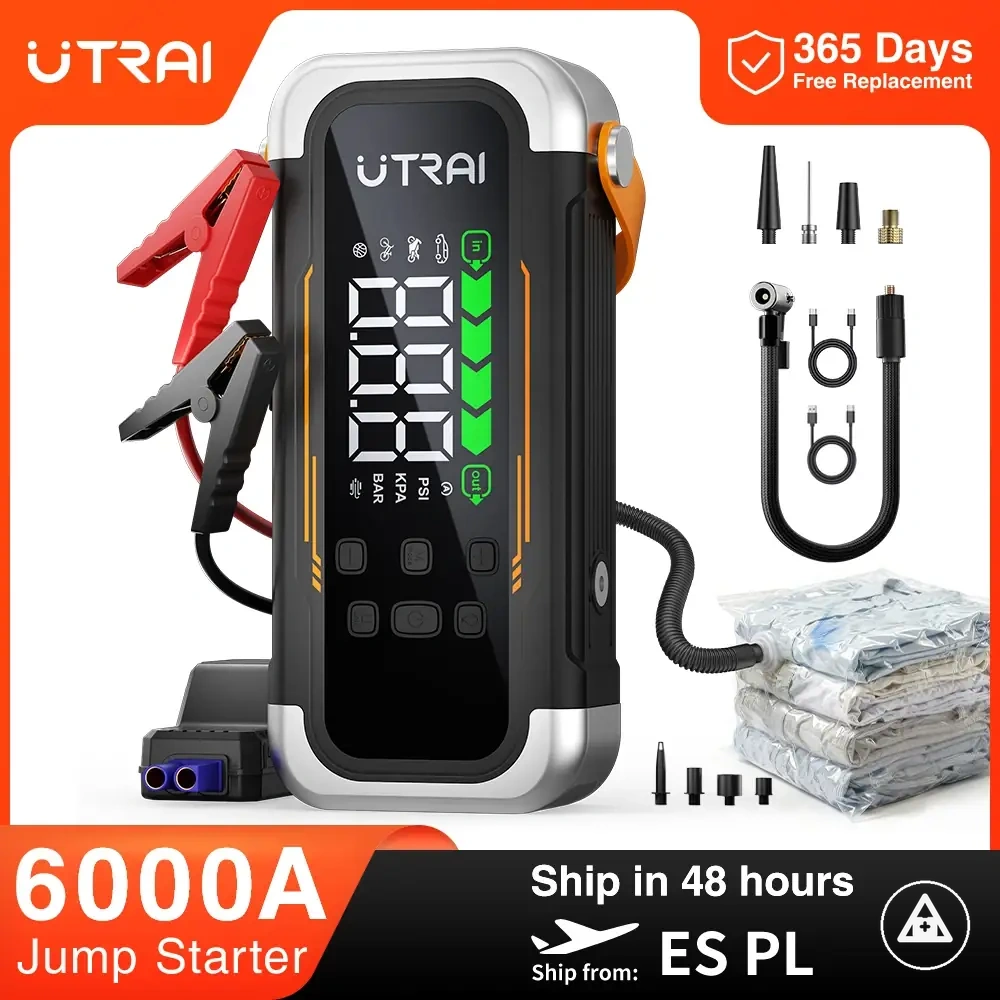
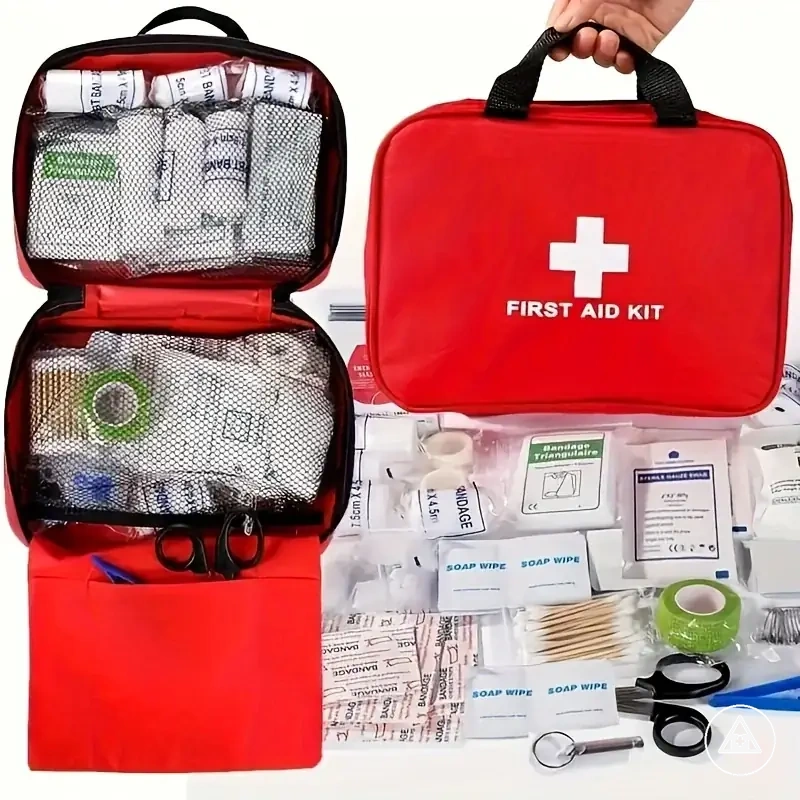
The products below are useful examples for comparing available options. Before buying, check that the compatibility criteria, key features, and product details match your needs.
When a Car Emergency Kit Is Worth Paying More For
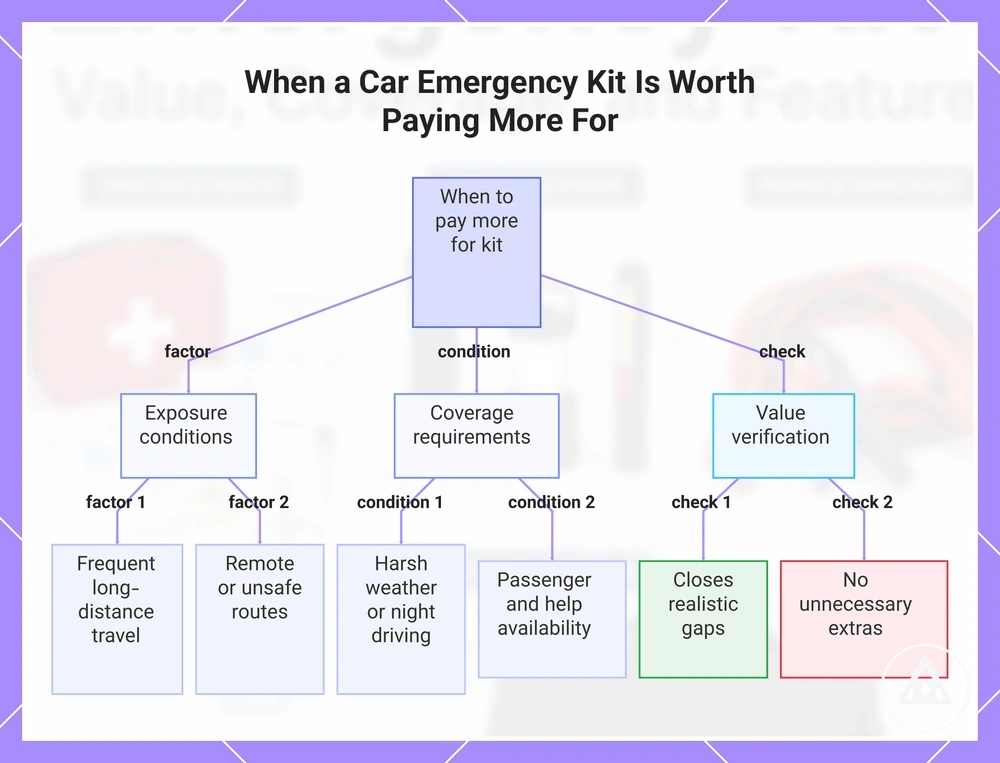
A car emergency kit is worth paying more for when extra coverage reduces realistic roadside risk. A higher-cost kit should add useful tools or supplies that match the driver’s exposure, not just more items. The decision should follow clear criteria tied to risk, coverage, and preparedness gaps.
Driving exposure can raise the value threshold when the vehicle is used often, travels longer distance, or moves through less predictable conditions. Remote routes may make extra coverage more useful when help availability is limited. Weather and night driving can also change the value of lighting, visibility, warmth, or other support items. Passenger needs may increase the importance of broader supplies when more people depend on the kit. A higher-cost kit fits better when these conditions create realistic roadside risk that the added coverage can help reduce.
When a Car Emergency Kit Is Worth Paying More For can be checked by verifying the decision signals that justify higher spend. Use the same selection criteria to connect added cost with actual risk, missing tools, and practical kit fit.
- Distance: Longer or more frequent trips may justify extra coverage when roadside needs are less predictable.
- Route risk: Remote routes may increase the value of broader support when help availability is limited.
- Weather: Harsh or changing weather may raise the need for stronger coverage if the kit has clear preparedness gaps.
- Night driving: Regular night driving may make lighting and visibility support more important.
- Passengers: Passenger needs may justify broader supplies when more people rely on the same kit.
- Help availability: Reduced access to quick help may increase the value of added tools or supplies.
- Missing tools: Paying more may be justified when the higher-cost kit closes realistic preparedness gaps.
Added cost is not justified when the extra items do not reduce realistic roadside risk. A broader kit may have limited value if the added tools duplicate existing supplies, do not match driving conditions, or create storage problems. Paying more is usually a stronger decision when extra coverage clearly fits the driver’s actual exposure and preparedness gaps.
This chart shows the criteria that justify paying more for a car emergency kit, including exposure conditions, coverage requirements, and value verification checks.
Driving Distance and Roadside Exposure
Longer driving distance and higher roadside exposure can increase the value of extra kit coverage. More time on the road can create more chances for delays, route changes, or roadside needs. The local selection cue is whether added coverage fits the trip distance, route type, traffic environment, and help availability.
Short trips may need less extra kit coverage when the traffic environment is familiar and help availability is higher. Commuting can increase value when driving frequency is high, even if each trip is not long. Long trips may make broader coverage more useful when route type, distance, or time away from support increases exposure. Remote driving can raise the value threshold when help availability is limited, but the choice should still stay within the parent worth-paying-more decision.
Weather, Night Driving, and Remote Area Risk
Weather severity, night driving, and remote area risk can make broader coverage more valuable when they increase roadside exposure. Visibility, warmth, lighting, tyre preparedness, and communication preparedness may become more relevant under tougher conditions. The right level of coverage depends on the driver’s environment and trip pattern.
Weather severity can affect visibility and warmth needs, while darkness during night driving may increase the value of lighting and warning-related preparedness. Remote roads can increase roadside risk when delayed assistance is more likely, making communication preparedness and tyre preparedness more relevant. Passenger vulnerability can also affect which coverage areas deserve greater attention, particularly when help availability is limited. These conditions can change the cost-value threshold because the usefulness of extra coverage depends on the level of exposure and expected roadside challenges.
When a Lower-Cost Car Emergency Kit May Be Enough
A lower-cost car emergency kit may be enough when likely roadside gaps are limited and basic coverage matches the driver’s situation. Reasonable value depends on whether the kit covers the most relevant needs without leaving important gaps unaddressed. Suitability remains conditional on driving conditions, available support, and existing preparedness.
Short driving distances, easy access to help, and low-risk routes can reduce the need for broader coverage in many situations. Drivers who remain close to populated areas or regularly travel familiar routes may face fewer conditions that require additional equipment. Help availability can also reduce the need for extra redundancy when support is usually nearby. These conditions often align with a lower-risk fit.
Existing vehicle tools can affect whether a lower-cost car emergency kit provides reasonable value. If basic roadside equipment is already available, the kit may only need to cover missing items rather than provide complete coverage from the start. Willingness to add missing items over time can also improve readiness without requiring a larger initial spend. A lower-cost kit may still need supplementation when roadside gaps remain.
When a Lower-Cost Car Emergency Kit May Be Enough depends on whether basic coverage matches the driver's situation. The checklist below verifies decision variables that can help determine whether lower-cost coverage is enough.
- Short driving distances are common and exposure to extended roadside situations is limited.
- Low-risk routes are used more often than isolated or less predictable routes.
- Easy access to help is usually available when assistance is needed.
- Existing vehicle tools already cover part of the preparedness requirement.
- Basic first aid supplies are available for minor roadside needs.
- Visibility items are present to support roadside awareness.
- There is willingness to add missing items if coverage gaps are identified.
Lower cost works best when the kit still covers the most likely roadside gaps. Missing first aid basics, visibility items, or other important preparedness needs can reduce value even when the purchase cost is low. The goal is to avoid unnecessary gaps rather than maximize item count.
A lower-cost car emergency kit can provide reasonable value when coverage aligns with actual driving conditions and preparedness needs. The decision depends on how well basic coverage, existing vehicle tools, and added items work together to reduce likely roadside gaps. Cost-value outcomes are usually stronger when the kit fits the driver’s specific situation rather than a generic coverage standard.
The products below are useful examples for comparing available options. Before buying, check that the compatibility criteria, key features, and product details match your needs.
This chart shows the key conditions and factors that determine whether a lower-cost car emergency kit provides sufficient coverage.